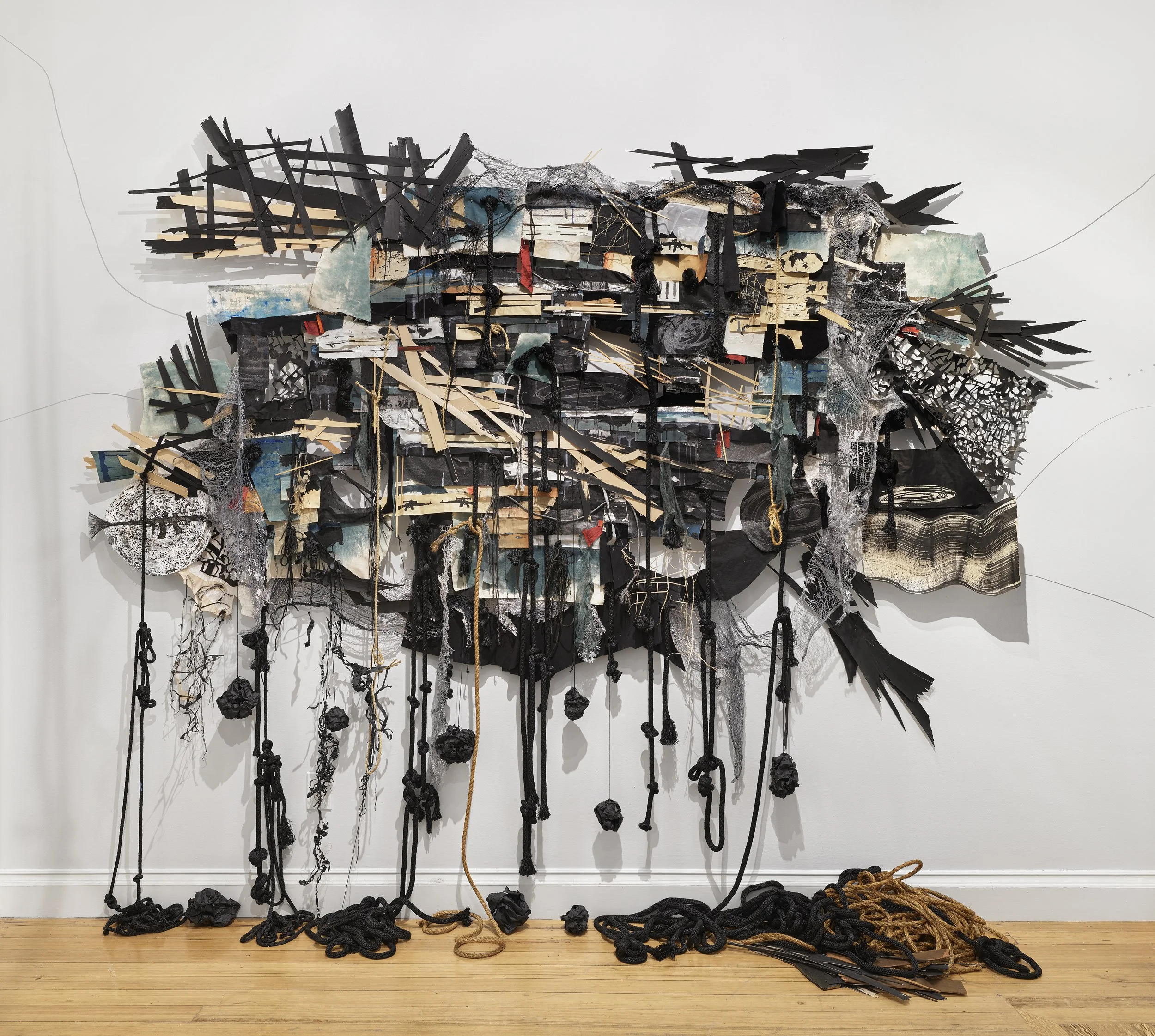
Heidi Whitman Maps a Violent History with "Ahab's Head: American Vengeance"
American violence is nothing new. Violence ushered in the birth of our nation and continues to guide its evolution. No banning of books or manipulation of curricula will dissolve the legacy of brutality buried in American soil. To face the towering assemblages, ghostly charts, and columns of painted rope in Heidi Whitman’s solo exhibition now on view at the New Bedford Whaling Museum is to confront that inheritance directly: the grief, bloodshed, aspiration and complexity braided into 250 years of American history.
Ahab’s Head: American Vengeance is a site-specific installation in which the artist addresses contemporary violence through the lens of Herman Melville’s Moby Dick; Or, the Whale. Whitman re-read the 1851 masterpiece in 2020 as the pandemic’s impact shut down her exhibition “Wayfinding” at the Addison Gallery of American Art, her studio, and the world. Rather than illustrate the text, Whitman reimagines its themes: vengeance as ideology, destruction as destiny, obsession as national temperament. Across collage, drawing, painting, sound, and immersive spatial intervention, Whitman builds an environment by mashing up literary myth and American history to provoke new readings of the 175 year-old book.

Heidi Whitman, Ahab's Head: American Vengeance, 2020-2025, Detail, Dimensions Variable, ink, gouache, acrylic, paper, cloth, canvas, string, rope, Cinefoil, wood, sound, and cast shadows. Photo Credit: Julia Featheringill.
To understand the exhibition, it’s helpful to read the passage that inspired it, from chapter 44 in Moby Dick “The Chart.”
While thus employed, the heavy pewter lamp suspended in chains over his (Ahab’s) head continually rocked with the motion of the ship, and for ever threw shifting gleams and shadows of the lines upon his wrinkled brow, till it almost seemed that while he himself was marking out lines and courses on the wrinkled charts, some invisible pencil was also tracing lines and courses upon the deeply marked chart of his forehead. For with the charts, of all four oceans before him, Ahabn was threading a maze of currents and eddies, with a view to the more certain accomplishment of that monomaniac thought of his soul…
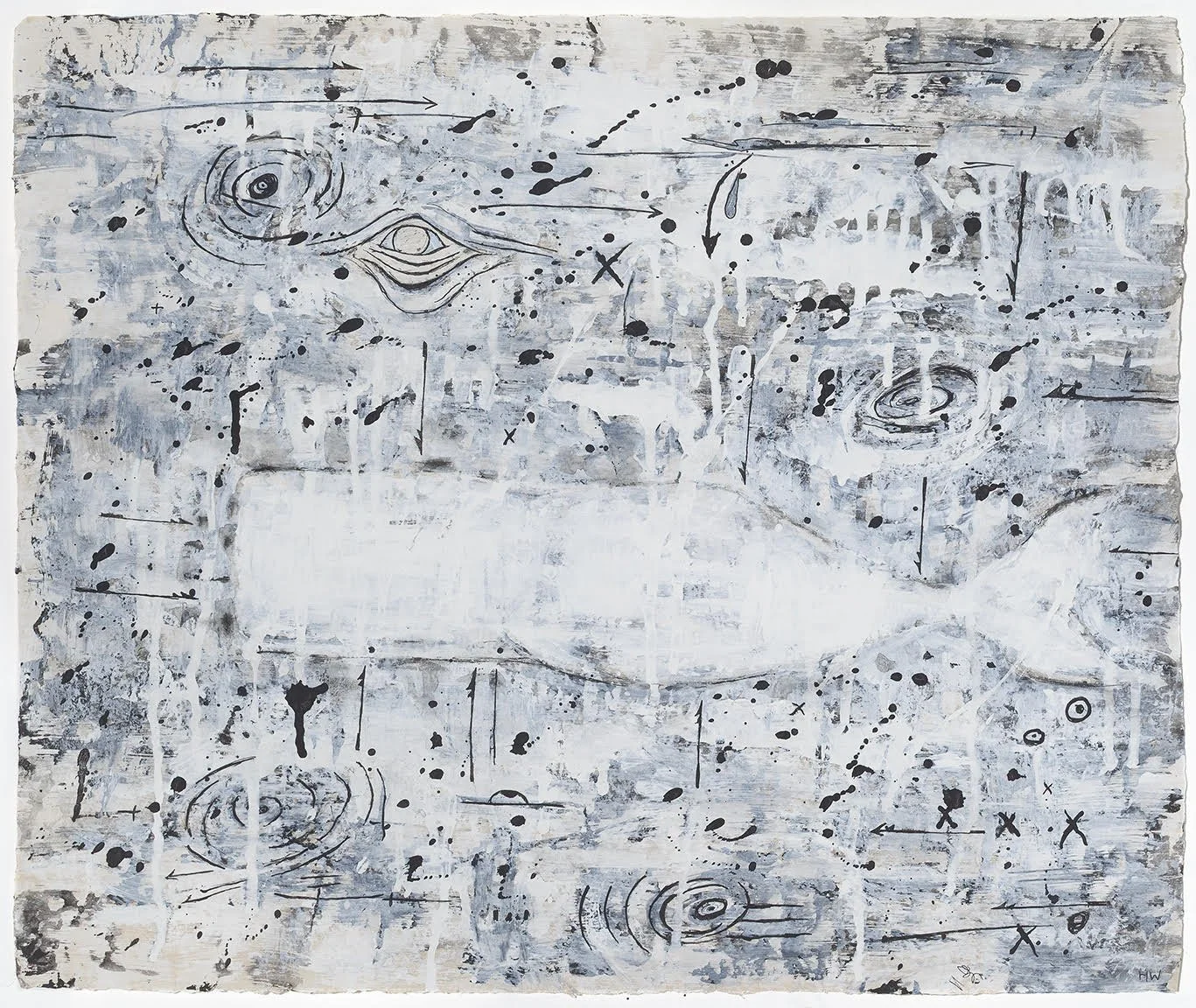
Heidi Whitman, Leviathan D(26), 2025. Ink, gouache, and acrylic on paper. Photo: Will Howcroft.
Directly on the walls of the gallery, Whitman drew silvery geometric maps, a mix of fictional and literal nautical charts which signal her intention for the show. Also included are a series of 17” x 20” paintings which draw attention to her unique vernacular. Whale tales, wrinkled eyes, strata, drips, arrows, harpoons, guns, nooses and the color white appear again and again throughout the show. These paintings and a few small collages flow from the main gallery into an adjoining hall. Don’t forget to look up above the main gallery entrance to see a collection of historic harpoons the artist selected from the museum’s archive.
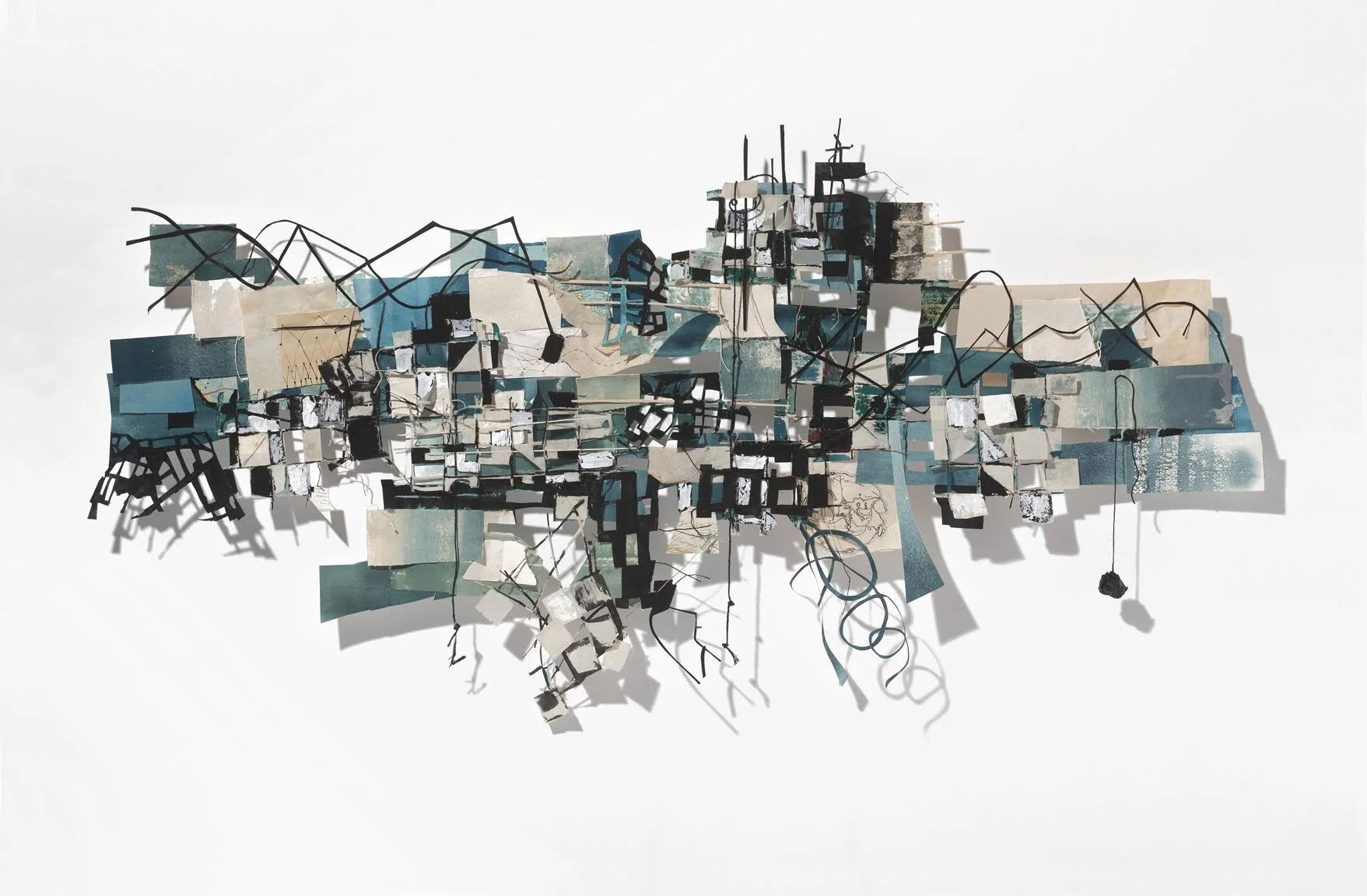
Heidi Whitman, A Very Long Journey, 2023. Ink, gouache, acrylic, paper, string and cast shadows. Photo: Will Howcroft.
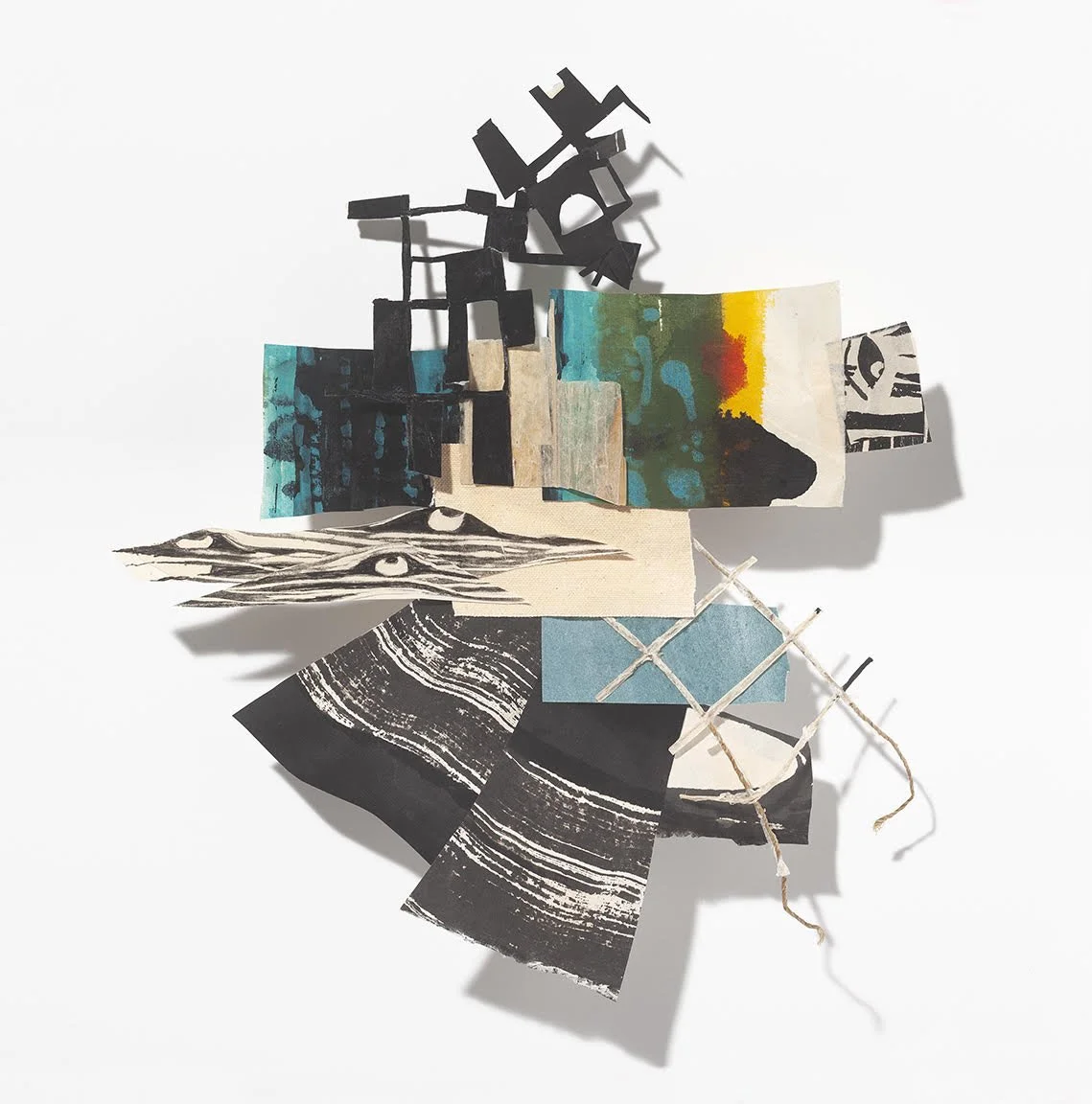
Heidi Whitman, Queequeg, 2025. Ink, gouache, acrylic, paper, string and cast shadows. Photo: Will Howcroft.
The exhibition is anchored by two enormous constructions depicting the beginning and end of Melville’s tale. On one side, a colossal head—Ahab’s or Moby Dick’s, the artist explained—it could be either or both. Over the course of the novel, Ahab’s megalomaniacal consciousness became almost indecipherable from the object of his quest. Bloody horizontal slats made of thickly painted wood and canvas recall the bandage and grommet works of Harmony Hammond. Whitman peppers her construction with drawings of whale and human eyes, their wrinkled lines and almond shape reminiscent of Chris Ofili’s all-knowing female genitalia in The Holy Virgin Mary (1996). Here, Whitman’s gooey drips of paint, thickly layered commonplace materials, and noose-like rope forms create the effect of a massive wound. This head holds the agonizing weight of history.

Heidi Whitman, Ahab's Head: American Vengeance, 2020-2025, Detail, Dimensions Variable, ink, gouache, acrylic, paper, cloth, canvas, string, rope, Cinefoil, wood, sound, and cast shadows. Photo Credit: Julia Featheringill.
Spoiler alert: at the end of Moby Dick, the whale destroys the Pequod, illustrating the ultimate supremacy of nature over human technology and ambition. Ahab’s obsession results not only in the destruction of his ship, but the death of all but one of his crew. Only Ishmael lives to tell the tale. Opposite Whitman’s head is an equally monumental assemblage representing that destruction. But here, it's not only the ship which experiences violence, but our country. The shape resembles not just a ship, but America. Semiautomatic assault rifles, Glocks, arrows and harpoons replace the whale eyes. Whitman loads this piece with painted and raw splinters of wood, so that we experience the ship’s destruction physically. Black rope and crumpled cinefoil dangle to the floor like entrails. Blue scraps of canvas replace red. The ocean’s endless expanse is a powerful metaphor for the indifference of nature, one of Melville’s starkest themes.

Heidi Whitman, Ahab's Head: American Vengeance, 2020-2025, Detail, Dimensions Variable, ink, gouache, acrylic, paper, cloth, canvas, string, rope, Cinefoil, wood, sound, and cast shadows. Photo Credit: Julia Featheringill.
It took Whitman five years to gain access to the perfect installation space at the New Bedford Whaling Museum, and it was worth the wait. High ceilings accentuate the drama of her hanging sculptures—tangled lines of painted rope, fabric, string and cut paper that fall from above, filling the middle space like wet strings of Ahab’s hair obscuring his view of the future. A thick spout of red and black fabric and rope gushes to the sky as if from Moby Dick’s blowhole, while at its base loops of rope bathe in pools of red acrylic paint.
“Is it that by its indefiniteness it shadows forth the heartless voids and immensities of the universe, and thus stabs us from behind with the thought of annihilation, when beholding the white depths of the milky way?”
Color operates almost as a psychological propellant. Red for blood, desire, and obsession. Black for ruin and evil. Blue for the sea and our human capacity for hope. But despite the power of other colors, white dominates. Whitman incorporates the white of the whale, of Christian faith, of heaven, and most importantly, the white Ishmael describes as “a colorless, all-color”—the hue of emptiness. In Whitman’s installation, white is the opposite of innocence, it is the pure clarity of nature’s indifference. What we call vengeance, the work suggests, may be nothing more than our refusal to accept that existential truth.

Heidi Whitman, Ahab's Head: American Vengeance, 2020-2025, Detail, Dimensions Variable, ink, gouache, acrylic, paper, cloth, canvas, string, rope, Cinefoil, wood, sound, and cast shadows. Photo Credit: Julia Featheringill.
Using space, color, form and material, Whitman illustrates the messiness of America’s defining contradictions. Aspiration and ambition meet bloodshed and death. The color red’s intensity meets black’s finality and white’s indifference. Obsessive mapping meet’s fate’s enigmatic mystery. We are nothing if not passengers on a fraught voyage of discovery and despair aboard a vulnerable yet resilient ship. Ahab’s Head: American Vengeance brings an iconic American literary treasure back to life with a big breath of contemporary anxiety.
Heidi Whitman’s Ahab’s Head: American Vengeance, is on exhibit at the New Bedford Whaling Museum from December 2025 to May 2026.
Cover image: Heidi Whitman, Ahab's Head: American Vengeance, 2020-2025, Detail, Dimensions Variable, ink, gouache, acrylic, paper, canvas, cloth, rope, string, wood, Cinefoil, sound, and cast shadows. Photo Credit: Julia Featheringill.
www.whalingmuseum.org
www.heidiwhitman.com