Yuko Oda: Decaying into Bloom at the Groton School
The Groton School spans a vast, bucolic campus 35 miles northwest of Boston, where it educates its elite student body as it has for 142 years. The school is known for famous alumni (President Franklin D. Roosevelt attended) as well as rigorous academics and Ivy League admissions. Heading to class on an early spring day, the last thing on most student and faculty minds is a Cambrian Explosion-like event—i.e., the end of nature as we know it. But that is exactly the type of scenario that concerns multidisciplinary artist Yuko Oda, whose solo exhibition Decaying into Bloom is on view at Groton’s Brodigan Gallery through May 10, 2026.
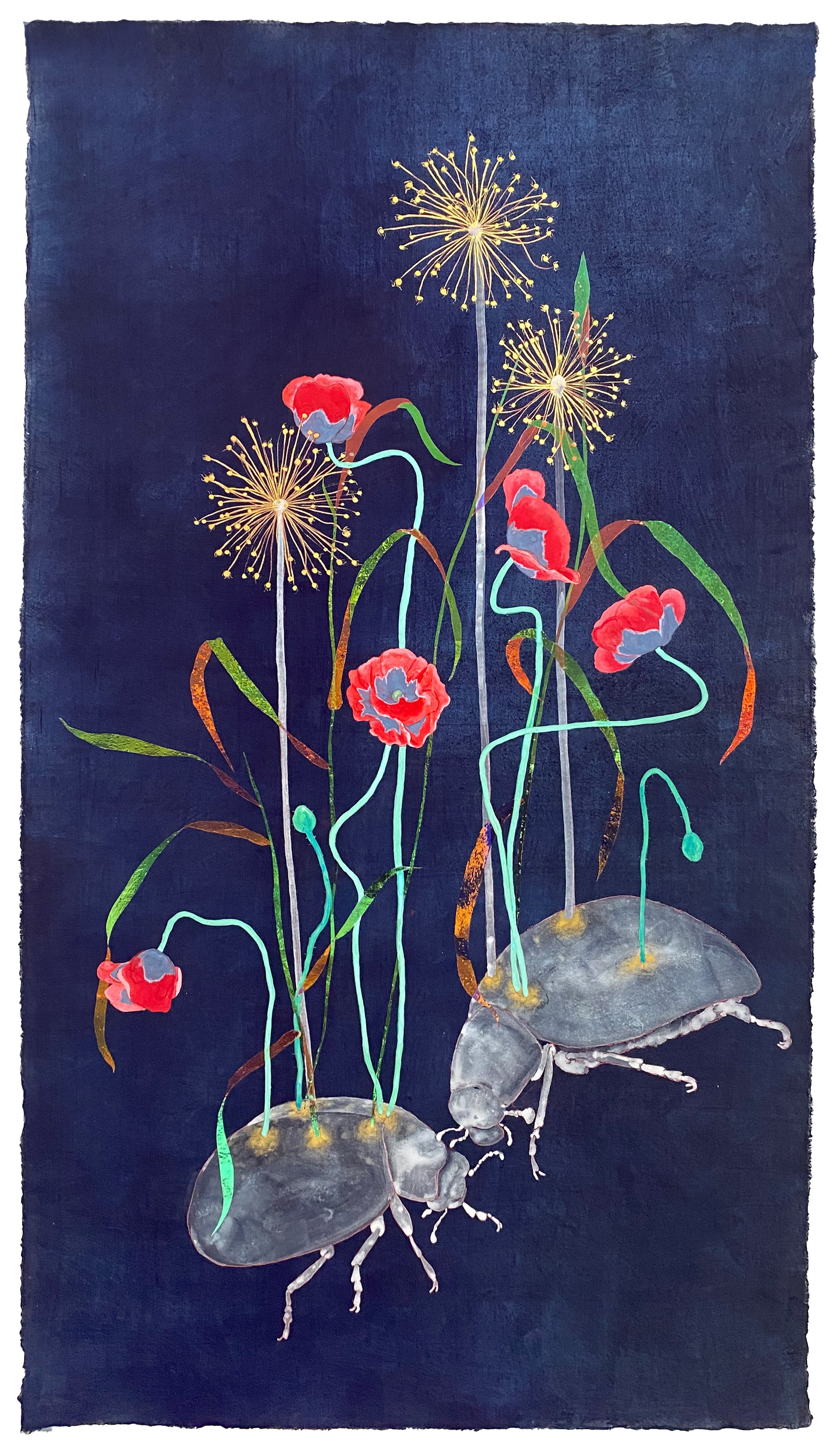
Yuko Oda, Together at Last, 2024. Japanese mineral pigments and plastic collage on paper.
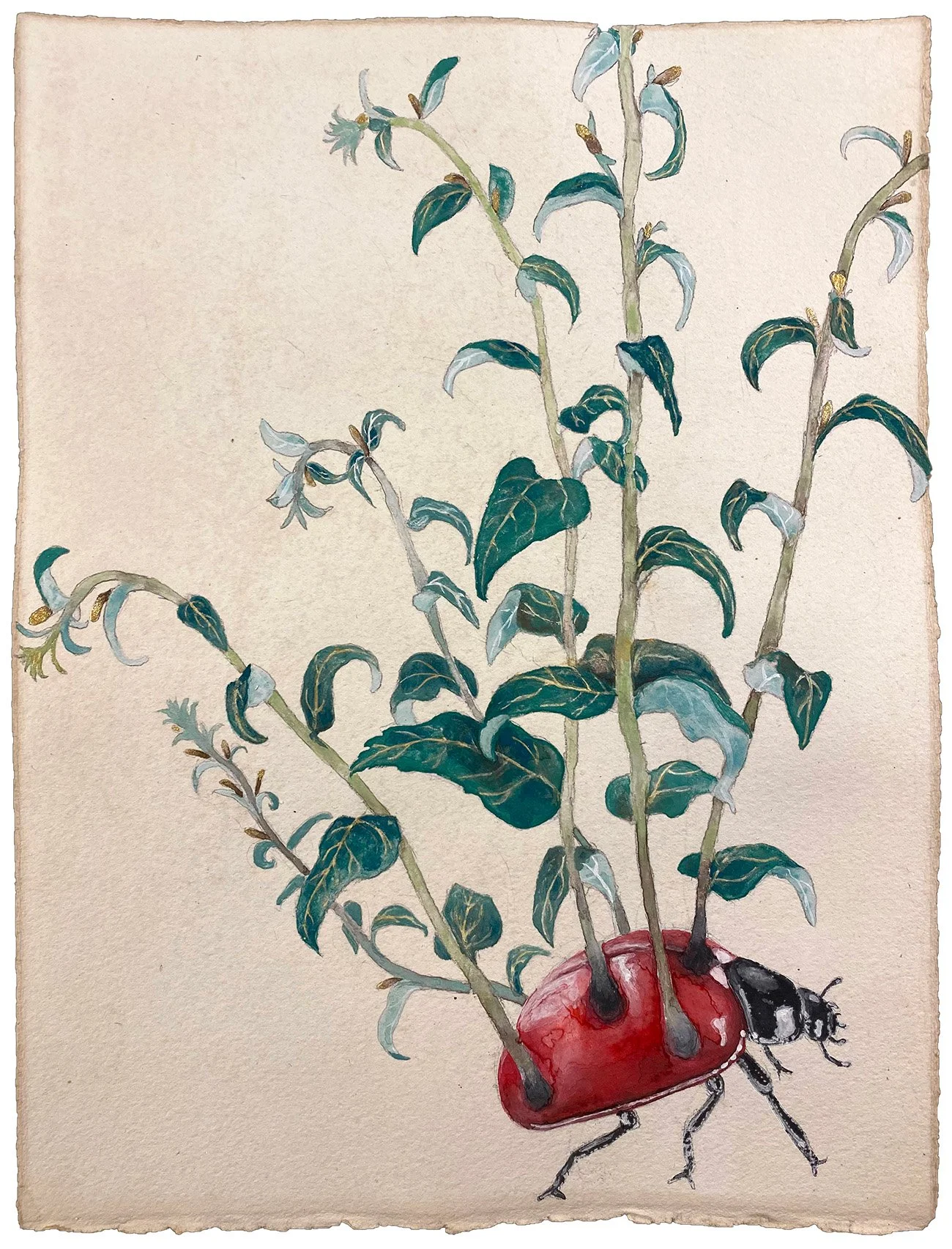
In the bright, intimate gallery, shimmering grasses and chromatic blooms rise from the backs of beetles on tall swaths of thick paper. Ladybugs swarm, lobsters sprout fungi, and butterflies fly apart. The sky glows red to blue to black. Leaves stretch toward nothingness and time stands still. The work asks: what might nature become after humans are gone?
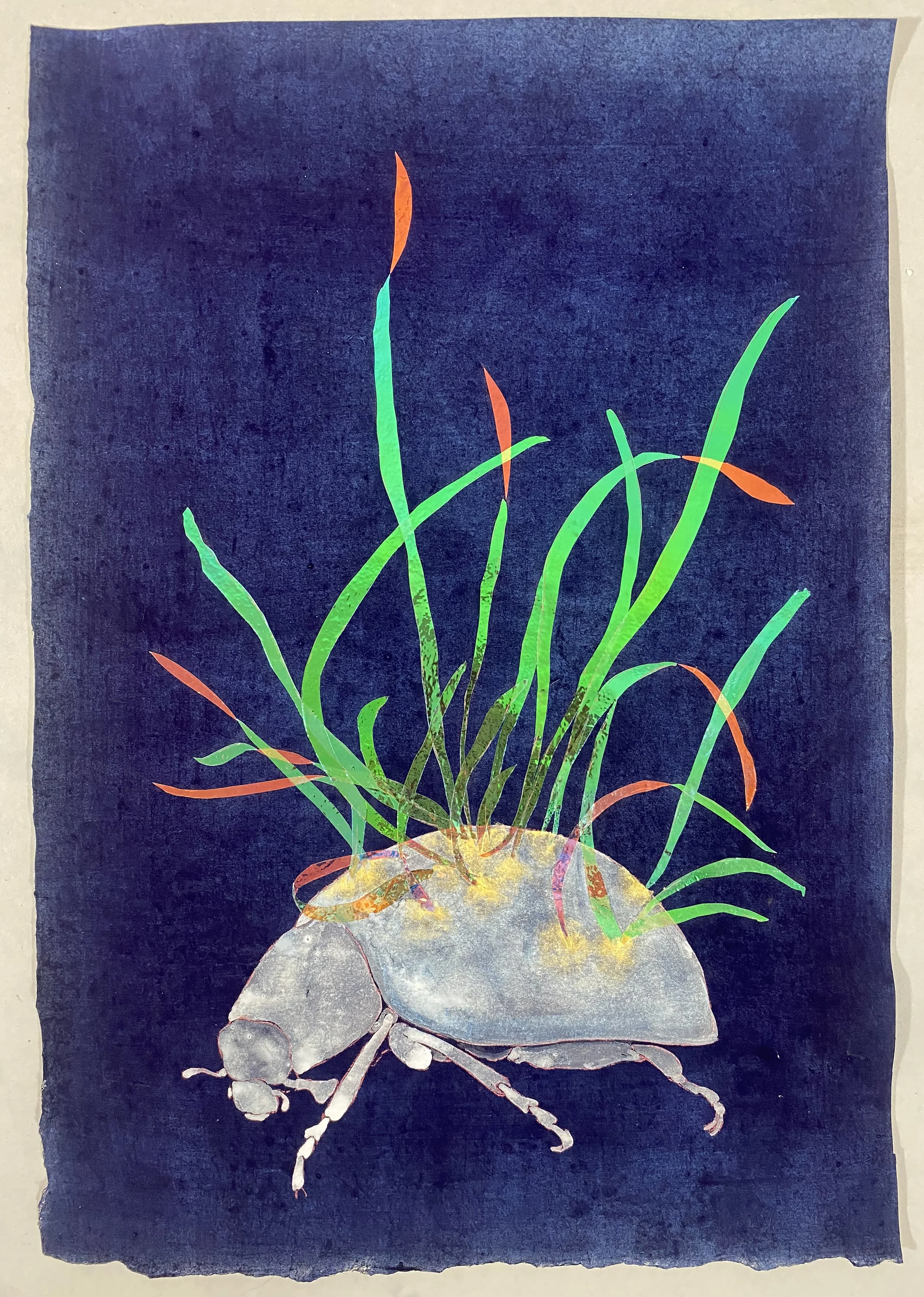
Yuko Oda, Migrant 2, 2025. Japanese mineral pigments and plastic collage on paper.
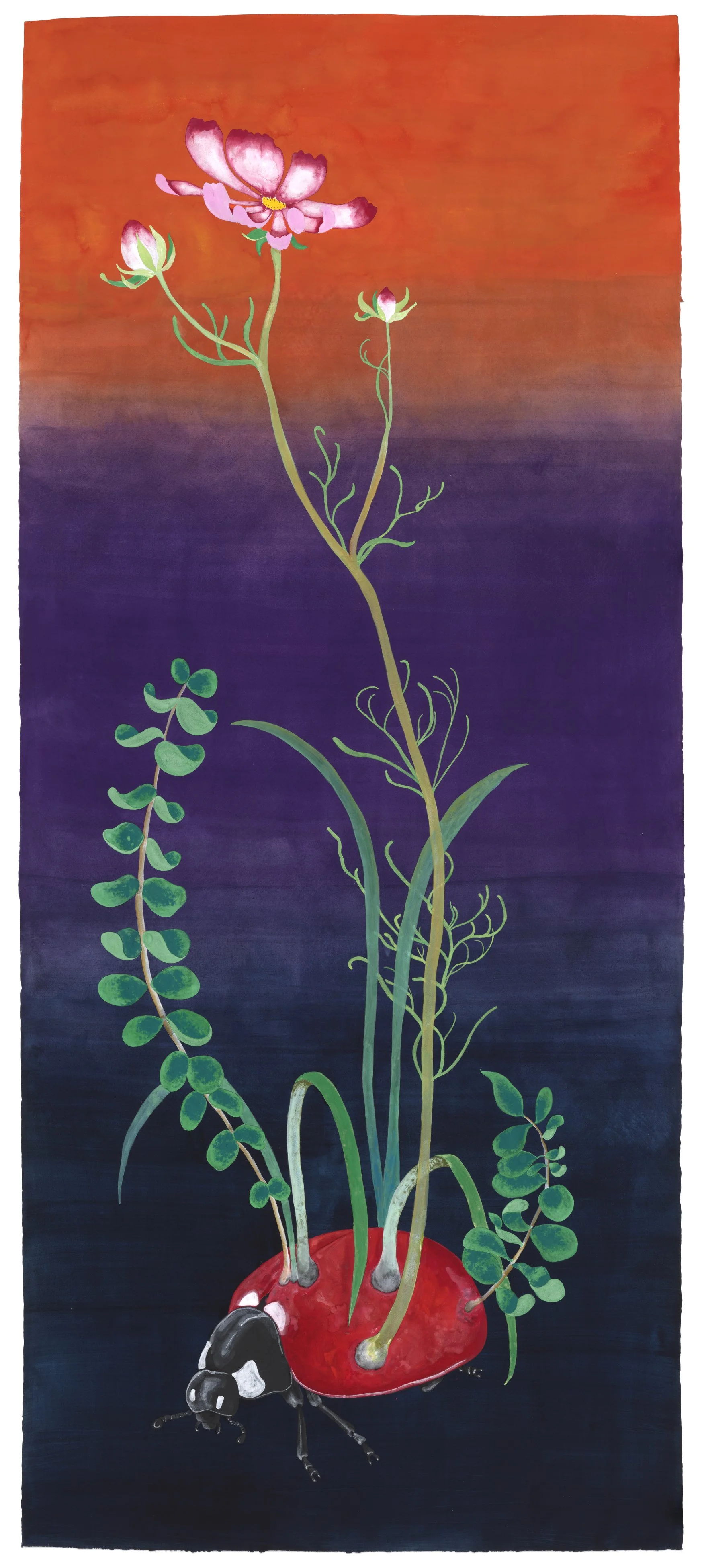
Yuko Oda, Signs of Spring 5, 2025. Japanese mineral pigments on paper. 102 x 45 inches.
Yuko Oda makes paintings, drawings, and sculptures that depict a speculative, post-human future in which insect, animal, plant, and germ life have adapted to survive and flourish. Influenced by books such as Braiding Sweetgrass by Robin Wall Kimmerer, Sacred Instructions by Sherri Mitchell, and Entangled Life by Merlin Sheldrake, Oda’s fantastic ecology embraces indigenous principals that modern industrial/capitalist societies reject. Reciprocity, interconnection, energy exchange—these are the secrets to her hybrid creatures’ vitality.
In a sitting area outside the gallery, Oda designed a small library with these and other relevant books. She created sketches of some of her signature motifs—cosmos, beetles, butterflies—and printed them out like pages from a coloring book. Colored pencils and markers are set up so that students and visitors can create their own interpretations of how nature might evolve. The artist is cognizant of the responsibility that comes with exhibiting at a school. Her pedagogical approach extended outwards to other institutions as well. She recently lectured at Harvard’s Museum of Comparative Zoology in a meeting with the Entomological Club.
Decaying into Bloom features work created over the last six years, greatly influenced by Covid, motherhood, and a residency at Cultivamos Cultura in Portugal. There Oda began incorporating death and decay into her hybridizations, imagining cyclical responses nature might have to a world choked by man-made material. Decomposing becomes part of the beauty.
As she put it, “I was making one-to-one hybrids, where the plant and the insect met. But in Portugal, I became aware of the decomposing and the death part. So, life and death as one system or one concept. I saw ants constantly carrying leaves and seeds and dead insects—the whole system of multiple species helping each other, or maybe some are helping and some are harming, but it doesn't matter, because it's still part of the cycle. To me, decomposing became death in order for life to happen again.”
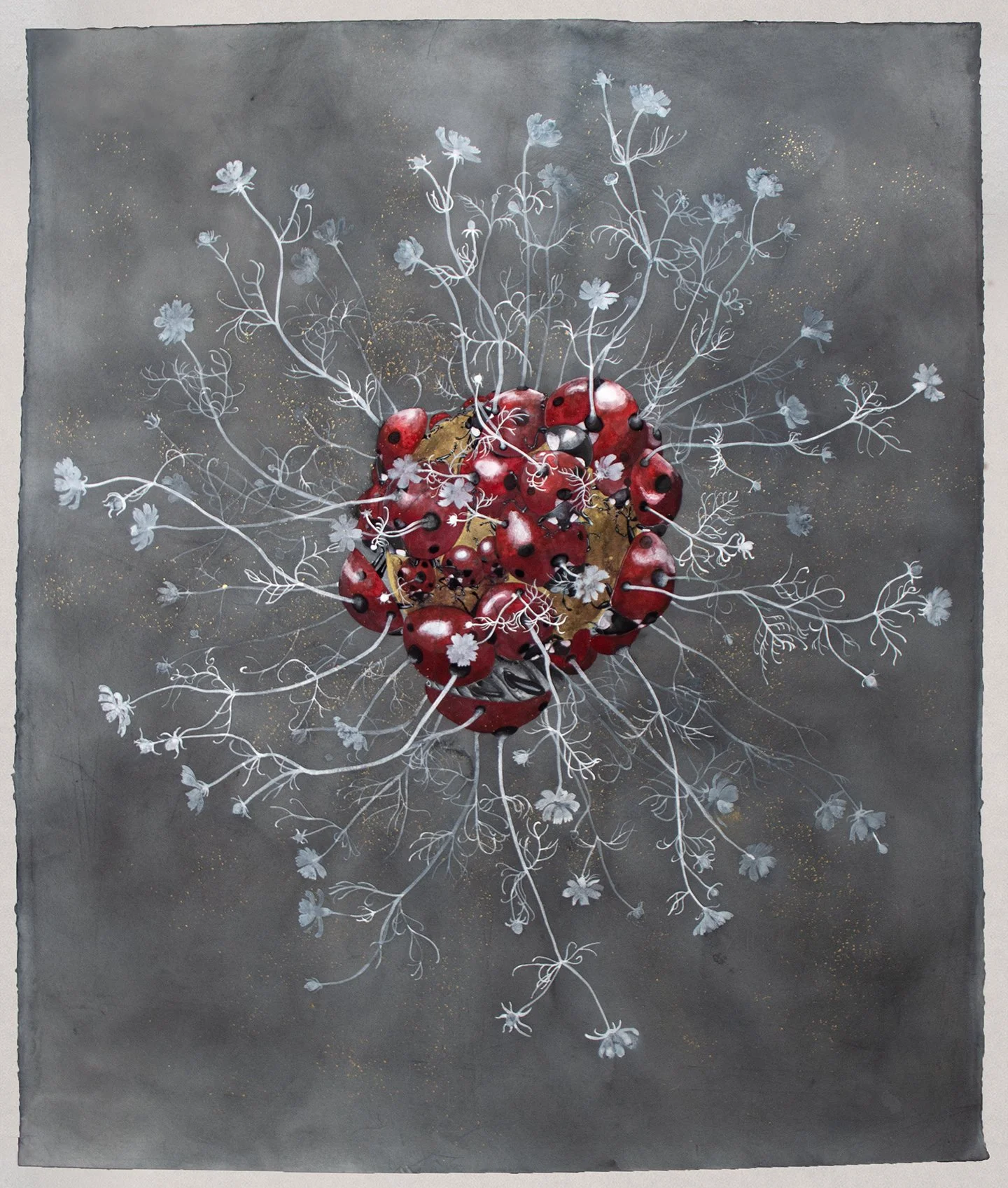
Yuko Oda, Protection 2024. Japanese mineral pigment and gold leaf on paper. 50 × 40 inches.
Oda grew up in Japan and the Philippines before moving to the U.S. for school. She studied philosophy and visual arts as an undergrad, and went on to earn an advanced degree from the Rhode Island School of Design. “As an immigrant oscillating between cultures, I empathize with living beings that migrate and adapt to survive.”
But while she draws a strong connection between her own experience as an immigrant moving from Asia to the United States, Oda’s primary concern is environmental. Her work asks whether we are capable of adopting indigenous practices of reciprocity and harmony with nature in order to change our current course toward destruction. But it also emphasizes nature’s wisdom in adapting no matter how recklessly humans behave.
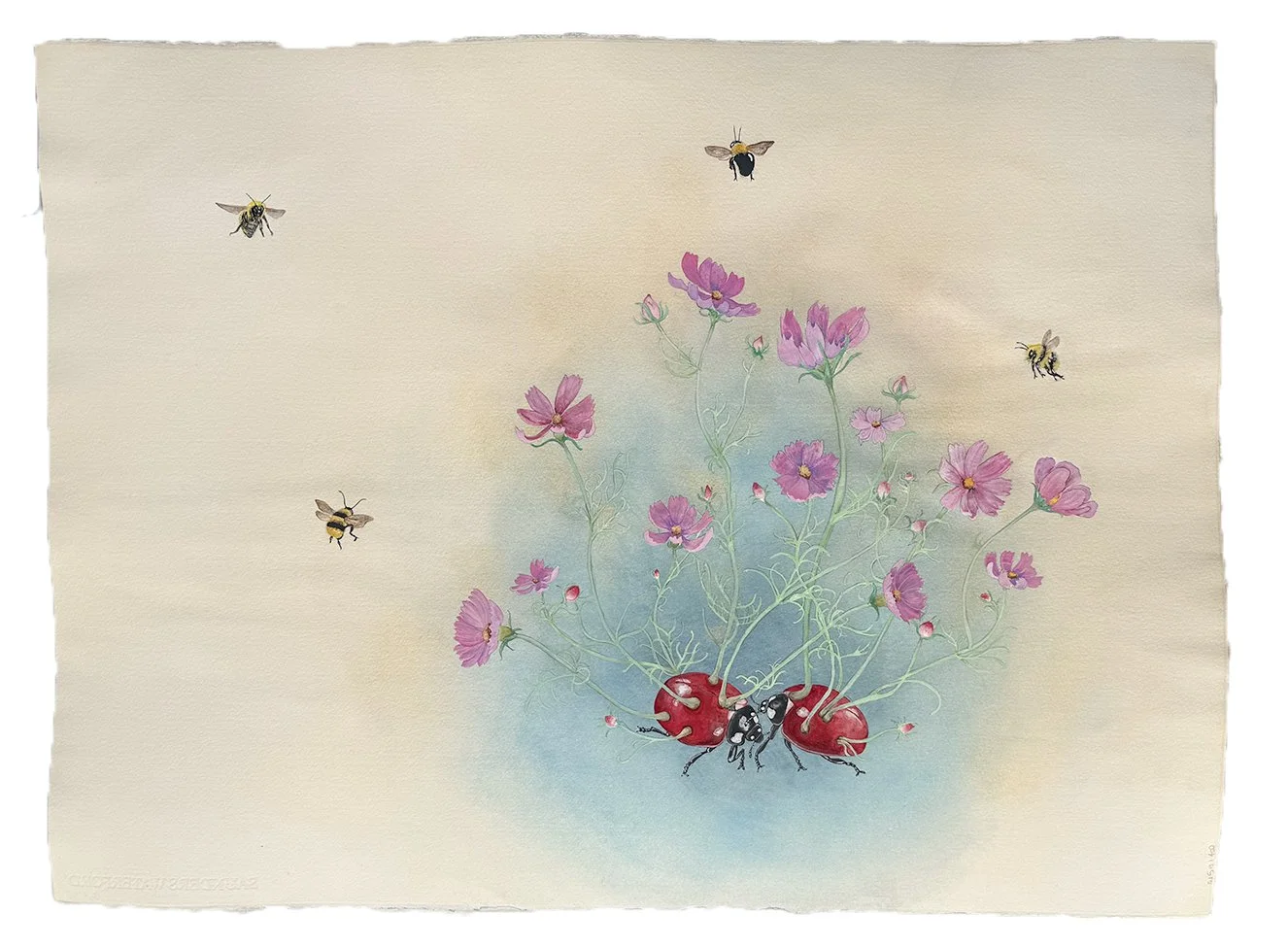
Yuko Oda, You Are Not Alone, 2024. Japanese mineral pigments on paper. 24 x 30 inches.
When she was twelve years old, Oda remembers seeing Nausicaä of the Valley of the Wind by the legendary Japanese filmmaker Hayao Miyazaki, in which giant insects called ohmu protect the planet against a deadly toxic threat. It doesn’t take long in the Brodigan Gallery to recognize the power of that influence, and appreciate the intellectual and aesthetic complexity behind her response.
“I've been thinking a lot about our place on the continuum of nature,” she told me when we met at the gallery, “and how we interact with living beings and nature on this planet. I've been affected by climate change, the devastation of nature caused by human beings, and also the grief and frustration that comes with that. But I truly believe nature will continue long beyond my own existence. Nature, animals, plant life—they are resilient. They will find a way to flourish and be beautiful. So, it’s a hopeful depiction of nature.”
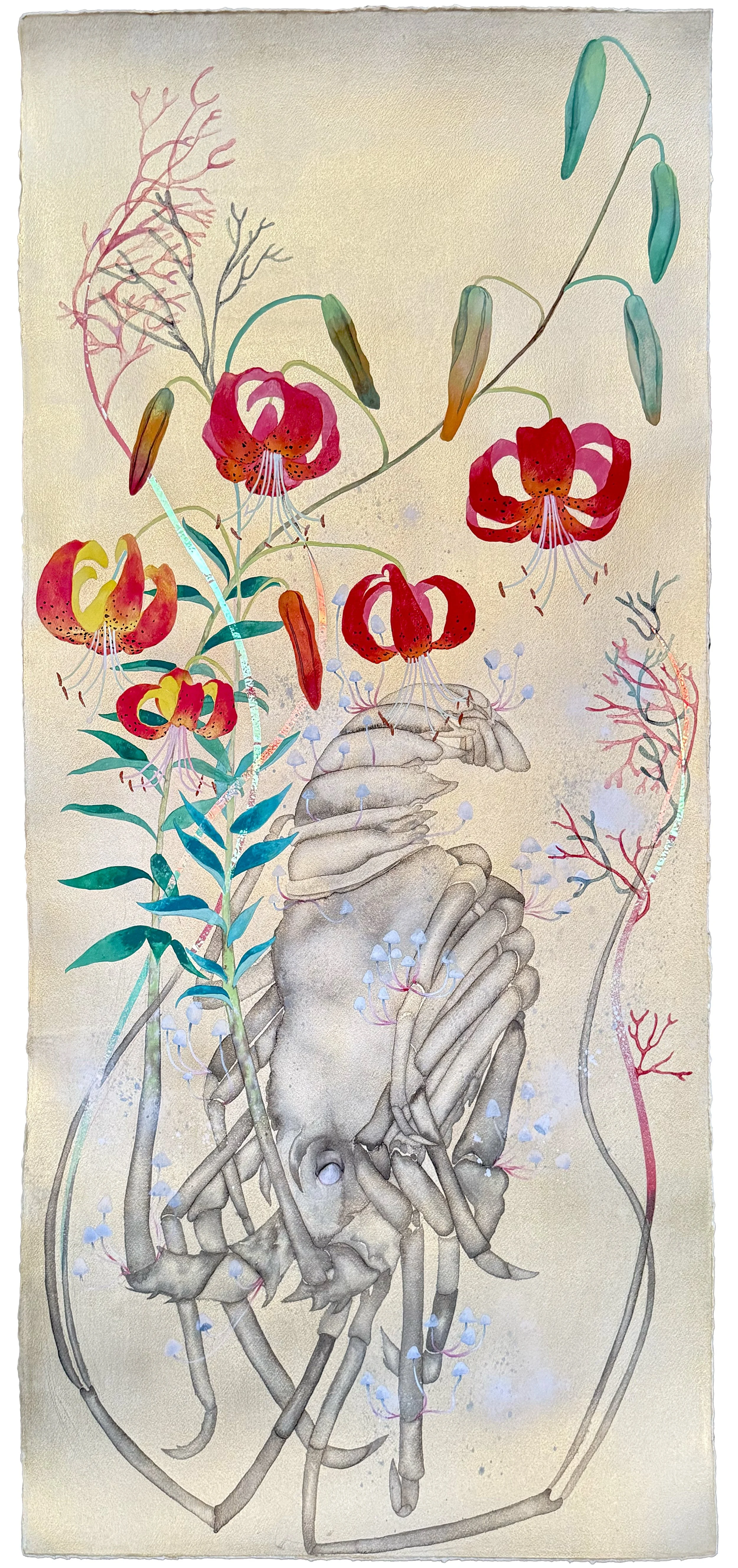
Yuko Oda, The Celebration, 2025. Japanese mineral pigments and plastic collage on paper. 45 × 21 inches.
“What I’m feeling is maybe something like a rebirth after the apocalypse. And perhaps that can feel dark but at the same time by making the work there is hope. By communicating through the work and sparking interest there can be hope and change, especially thinking about these topics with students or children.”
Oda makes her paintings on cotton Arches paper produced in France, and Japanese Kumohada paper made from mulberry fiber. These provide a “cloud-textured” support medium for the mineral pigments she sources from Japan. The Japanese pigment paints were used by her grandmother who owned a kimono making company.
“The mineral pigments were traditionally used on the silks to paint the kimonos,” she explained. “I grew up watching artisans painting the silks. So I've always been connected to that process. I was always fascinated in the Japanese mineral pigment painting called Nihonga, traditional Japanese watercolor painting using Sumi ink, which is compressed charcoal. The whites are crushed oyster shells. The reds are different minerals, but one is cochineal—crushed bugs.”
As seen in Together at Last, The Celebration, and Migrant 2, she often incorporates iridescent plastics into the compositions. In this way her work recognizes the reality that even in a distant future, synthetic materials will intertwine with organic.
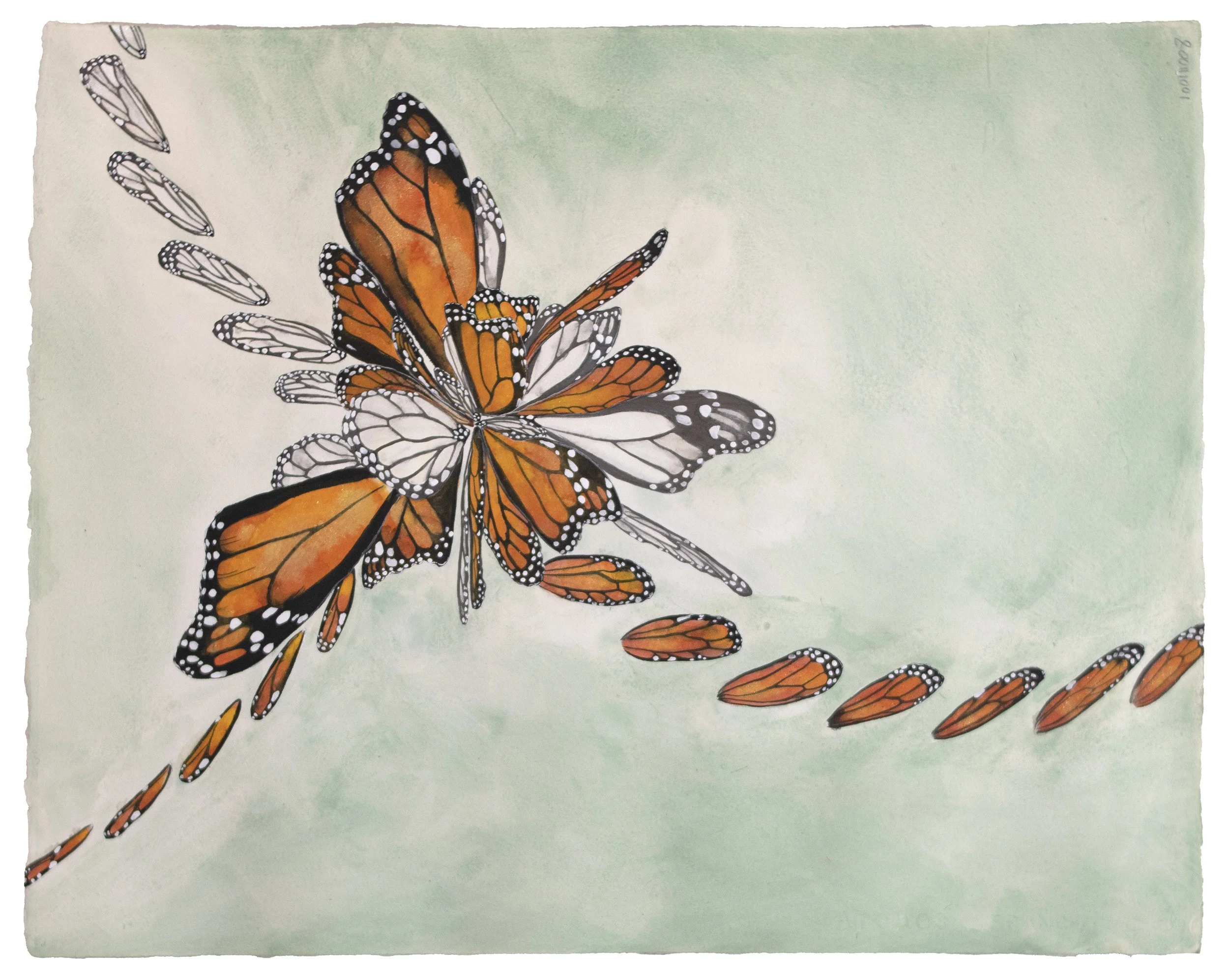
Yuko Oda, New Formations, 2024. Japanese mineral pigments on paper. 16 x 20 inches.
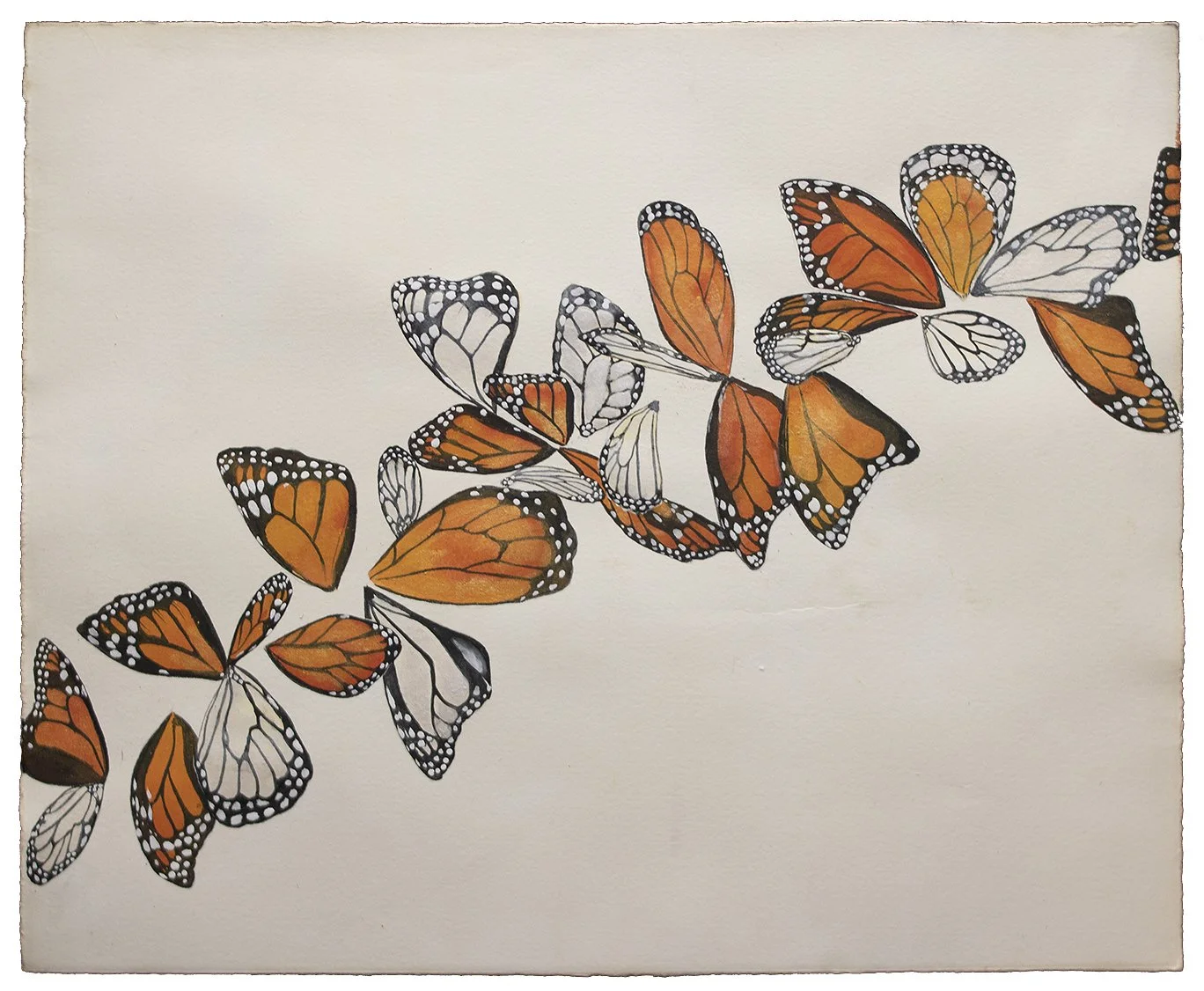
Yuko Oda, The Scattering, 2024. Japanese mineral pigments on paper. 14 x 17 inches.
In her newer work, Oda has been exploring leaving the rectangle shape, opening up the paper, and breaking through the confines of flat paper. She uses synthetic iridescent plastic and tempered glass to investigate porous or transparent alternative substrates. The idea of letting light through and moving the work away from the wall allows her to think about material transformation. She asks, “What is happening to this fiber? Maybe the synthetic is decomposing the paper, and the flowers are decomposing but still blooming, or being kind of decayed, but still blooming.”
“I’m using mulberry fiber and oyster shells to make art that is organic but at the same time, I’m bringing in these iridescent plastics and collaging them into these compositions. And these plastics indicate the other end of the spectrum, the synthetic part of nature. I’m expressing the coexistence of the synthetic and the organic in our nature. It’s still beautiful, but there’s also something dystopian about it.”
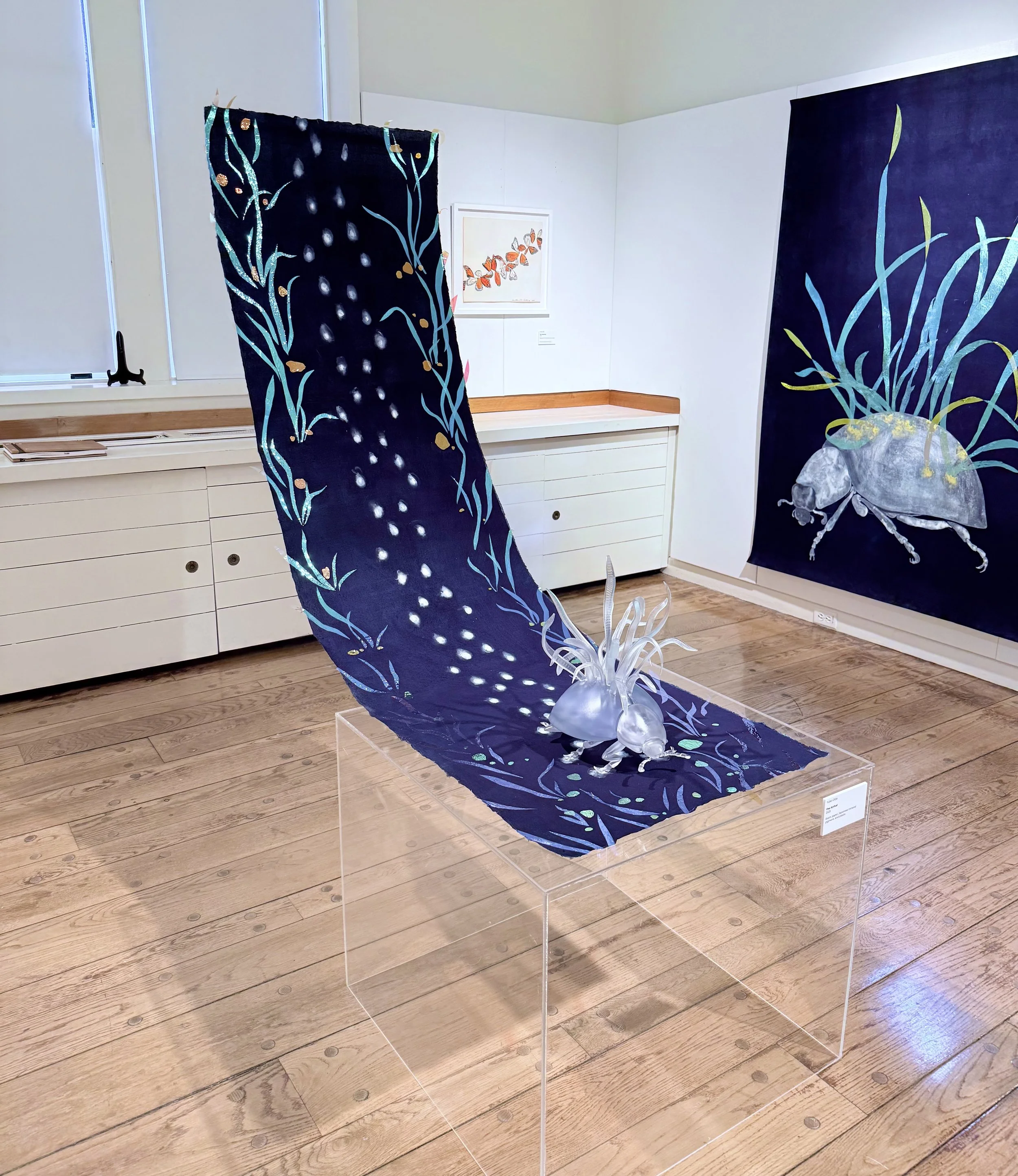
Decaying into Bloom installation at Groton. Image: Yuko Oda.
Decaying into Bloom is on view through May 10, 2026 at the Groton School’s Brodigan Gallery.
Cover Image: Yuko Oda, Ladyweed, 2023. 14 x 10 inches. Japanese mineral pigment on paper
All images courtesy of the artist.