Banu Cennetoğlu's Gilded Message
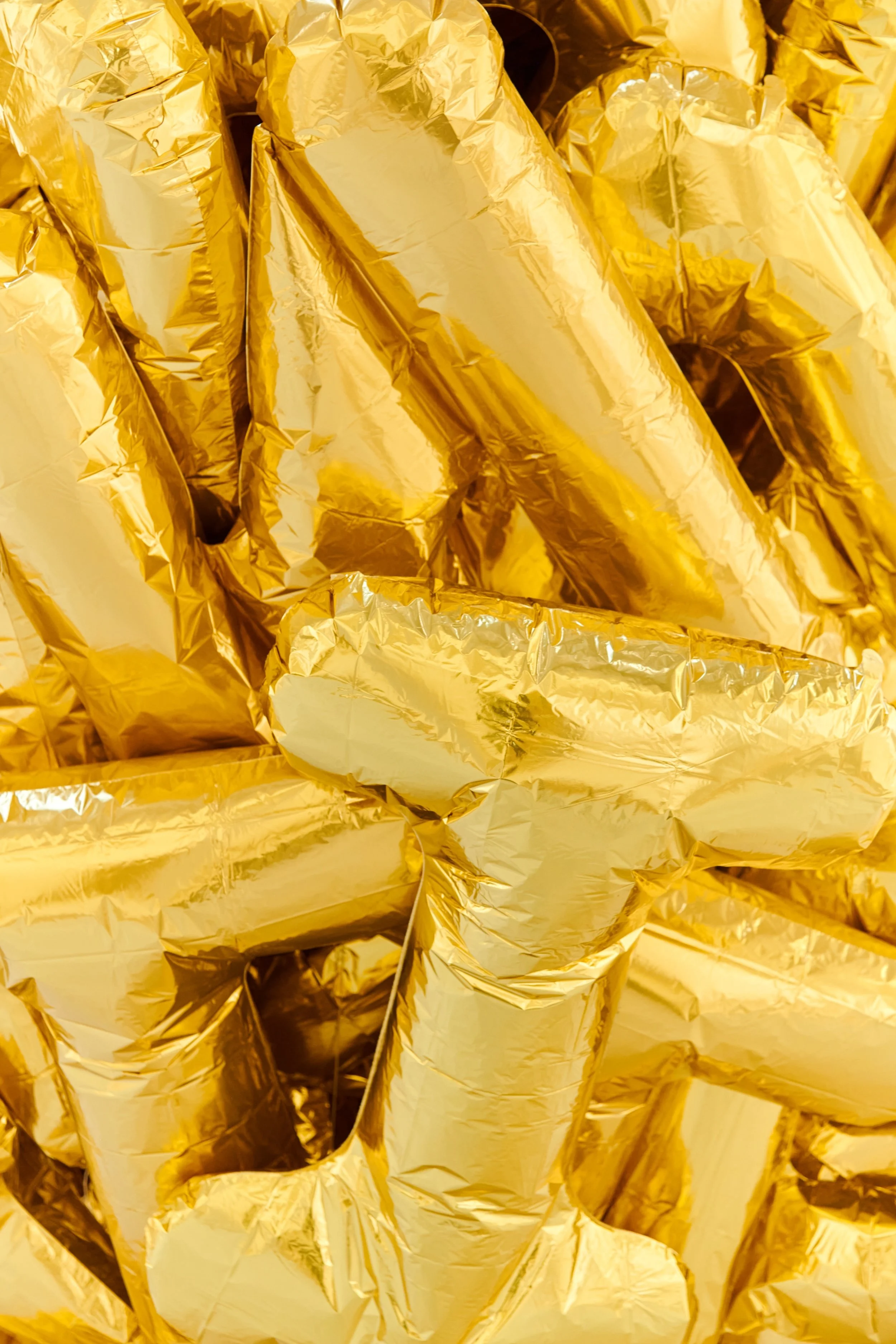
Don’t worry. These are not images from a Kardashian birthday party, or a foyer in the home of a Russian oligarch. This is right? by Turkish artist Banu Cennetoğlu, spelling out two of the thirty articles of the Universal Declaration of Human Rights (UDHR) in gold Mylar letter balloons. A spectacle of materialized intention, an outsized embrace of art’s ability to give shape to unenforceable truths, this work is a portrait of time itself.
The latest iteration of Cennetoğlu’s ongoing project, right? will be on view at the MassArt Art Museum (MAAM) from September 30, 2026 through February 28, 2027. At MAAM, the artist considers UDHR Articles 25 and 26.
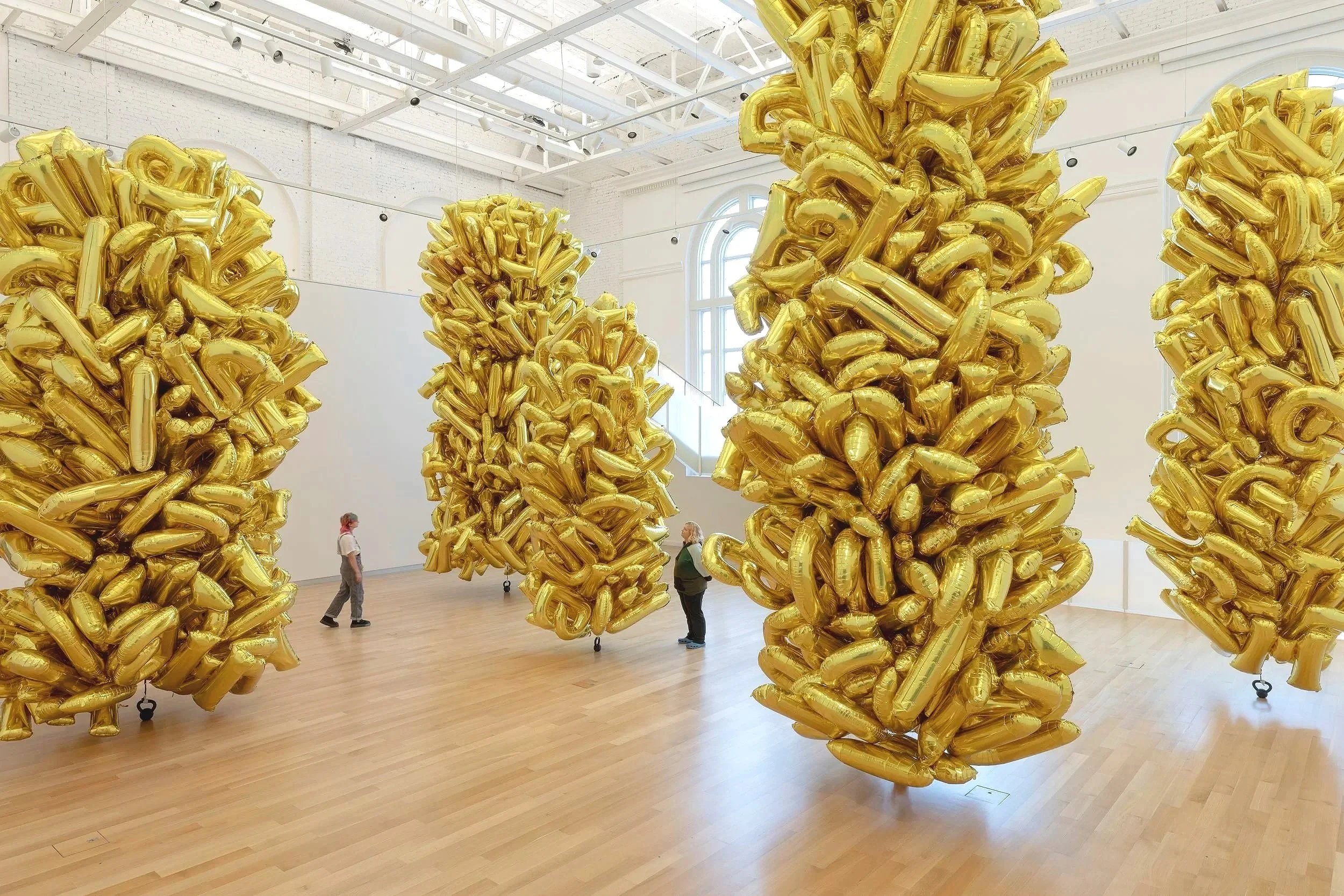
Banu Cennetoğlu: right?. Installation view: MassArt Art Museum (MAAM), Boston. Photo: Mel Taing ’16.
Banu Cennetoğlu, who lives in Istanbul, makes work interrogating language, symbols, systems of power, and their impact on human experience. With each invitation to show the work, Cennetoğlu spells out successive UDHR articles letter by letter, sentence by sentence, in gold, extra large, Mylar balloons. These unintelligble clusters start out as imposing totems, and deflate slowly over time.
In Boston, right? opens simultaneously with Robert Lazzarini’s show metes and bounds, including three “quivering American flags and mathematically distorted sculptures of patriotic symbols like George Washington and the bald eagle,” (The New York Times) originally made for the U.S. Pavilion at the 2026 Venice Biennale. Seen together, the shows highlight liberties and freedoms often taken for granted, such as human rights, citizenship, and international protections.
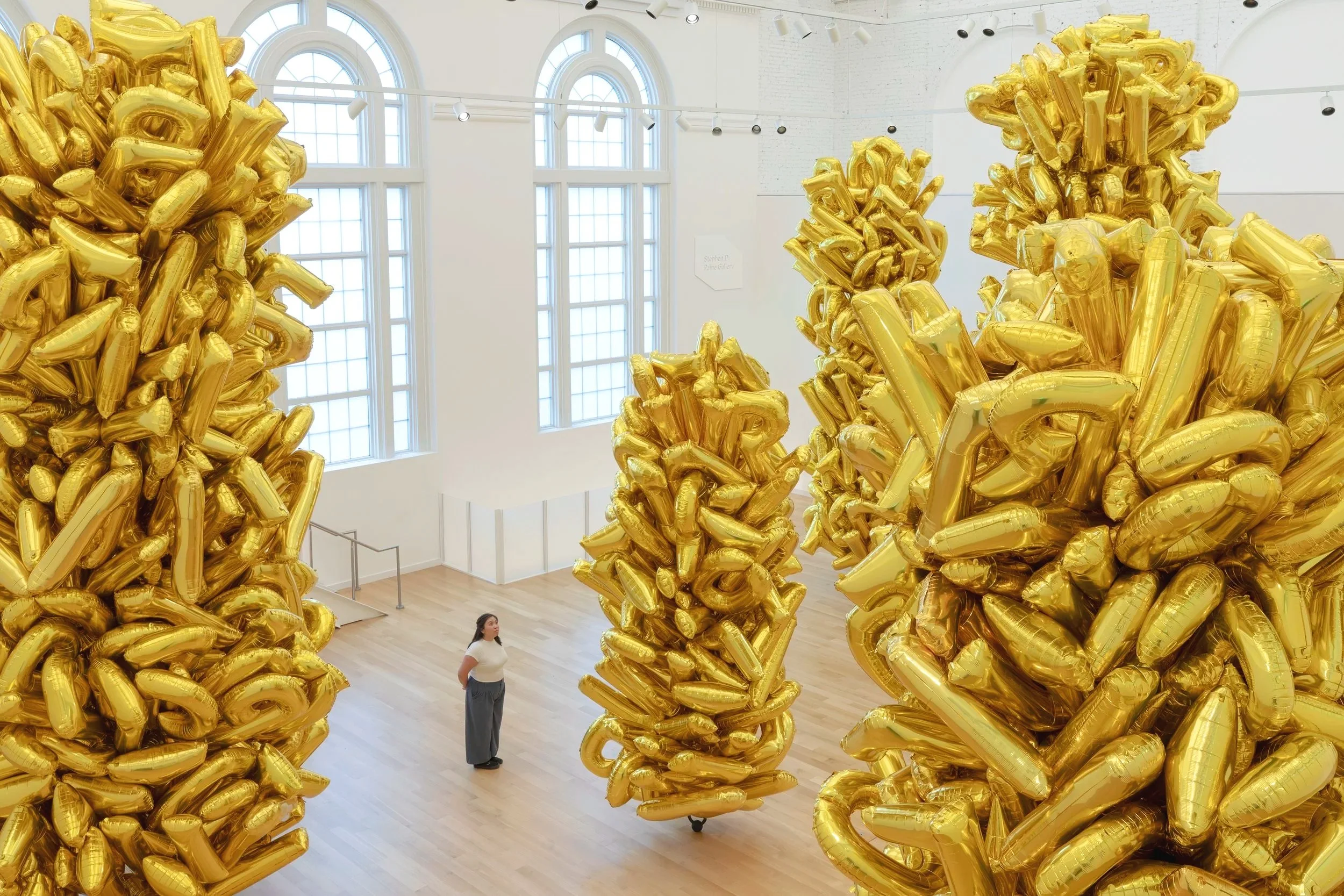
Banu Cennetoğlu: right?. Installation view: MassArt Art Museum (MAAM), Boston. Photo: Mel Taing ’16.
The Universal Declaration of Human Rights (UDHR) was adopted by the General Assembly of the United Nations in 1948 in response to the atrocities of WWII and as a result of significant effort by the UN Commission on Human Rights, chaired by Eleanor Roosevelt. Today the UDHR is considered the most translated text in the world, a foundation of the International Bill of Human Rights, completed in 1966.
In a conversation with the artist in 2024, critical legal scholar Başak Ertür described right? as the artist’s material consideration of the discrepancies between the promises made in international human rights declarations and their real world application. Given the state of human rights today, Cennetoğlu’s work could not be more timely.
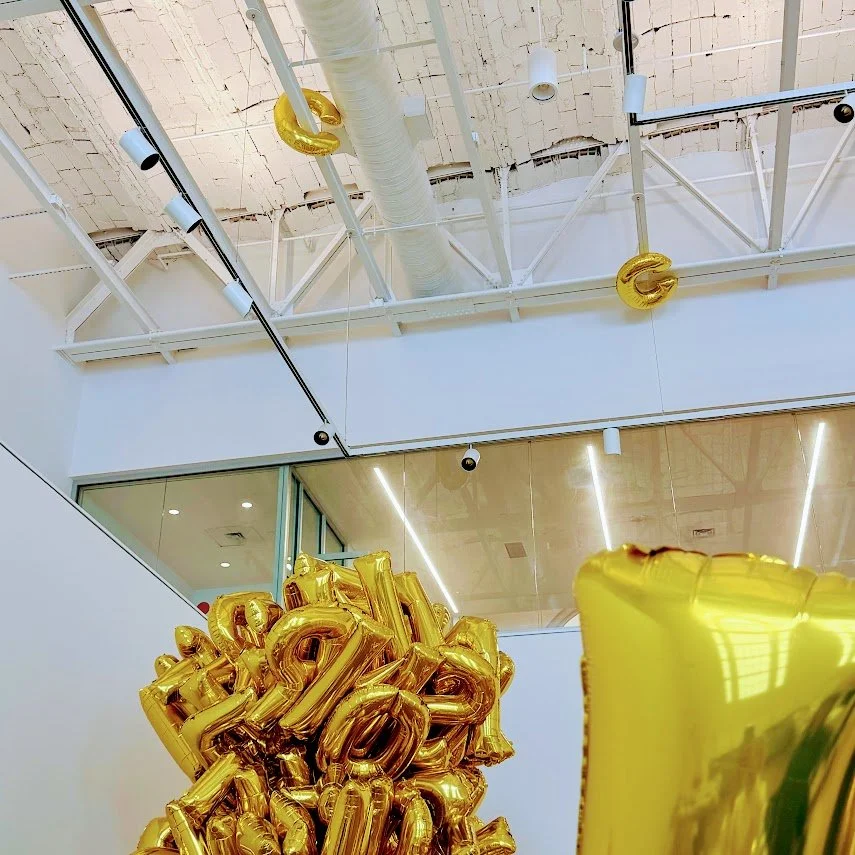
Letter Cs float to the ceiling of MAAM during installation. Photo: Robin Hauck.
I meet the artist upstairs in MAAM’s Paine Gallery during installation. Rows of truncated, half-formed balloon clusters fill the space, attached to various stools and weights and awaiting the letters needed to complete their sentences.
MassArt student assistants sit on folding chairs manning industrial helium tanks. On tables covered in neat piles of packaged gold letters are printed copies of UDHR Articles 25 and 26, marked up to show which letters have been inflated and which are missing. Missing on the day I arrive is the letter C.
Warm and calm, Cennetoğlu explains that all packages labeled C arrived at the gallery containing instead the letter B, so they’re waiting for Cs to show up. If she is stressed about the delay, she doesn’t show it, and later I realize that missing the letter C is an apt metaphor for one of the work’s primary questions: does language have any real meaning without sustained, coordinated action? In thinking about human rights and political responsibilities, how do we understand the role of language, contracts, treaties, and documents, as time reveals inaccuracies and omissions?
The work pointedly asks whether declarations like the UDHR are nothing more than air. After all it is not law, and depends on states to enforce its mandates. In Turkish, boş laf translates to "empty word" or "empty talk," used to describe words that have no substance (like a deflated balloon). Is the Declaration performative in the legal sense as described by Başak Ertür — a statement that does something by being said — or performative as we now understand it, meaning for show?
We walk through the rows of balloon clusters as Cennetoğlu tells me about this iteration of her project. Article 25 states that everyone has the right to a healthy, safe standard of living. Article 26 states that everyone has the right to education.
Article 25
(1) Everyone has the right to a standard of living adequate for the health and well-being of himself and of his family, including food, clothing, housing and medical care and necessary social services, and the right to security in the event of unemployment, sickness, disability, widowhood, old age or other lack of livelihood in circumstances beyond his control.
(2) Motherhood and childhood are entitled to special care and assistance. All children, whether born in or out of wedlock, shall enjoy the same social protection.
Article 26
(1) Everyone has the right to education. Education shall be free, at least in the elementary and fundamental stages. Elementary education shall be compulsory. Technical and professional education shall be made generally available and higher education shall be equally accessible to all on the basis of merit.
(2) Education shall be directed to the full development of the human personality and to the strengthening of respect for human rights and fundamental freedoms. It shall promote understanding, tolerance and friendship among all nations, racial or religious groups, and shall further the activities of the United Nations for the maintenance of peace.
(3) Parents have a prior right to choose the kind of education that shall be given to their children.
My response to reading the texts: ask the 22 out of every 10,000 Americans experiencing homelessness if they feel they are enjoying those rights. Ask the 13-year old boy forced to testify at immigration court in Harlingen, Texas if he is enjoying those rights. Ask Armenians, Kurds, Indigenous groups, Rohingya Muslims. Ask those in devastated areas of Ukraine, Gaza, Sudan, Myanmar.
Cennetoğlu tells me up front that she doesn’t believe art can inspire real change. In a much-discussed talk at Kunsthal Charlottenborg in Denmark she compared her work to a paper cut — something small but sharp, negligible but lingering. As lofty as her gilded towers may be, she does not expect a monumental response. Seamus Heaney wrote in The Government of the Tongue: "no lyric has ever stopped a tank." Cennetoğlu hopes the work will simply provoke questions.
“My only hope is that the formation and transformation [might] create possibility.”
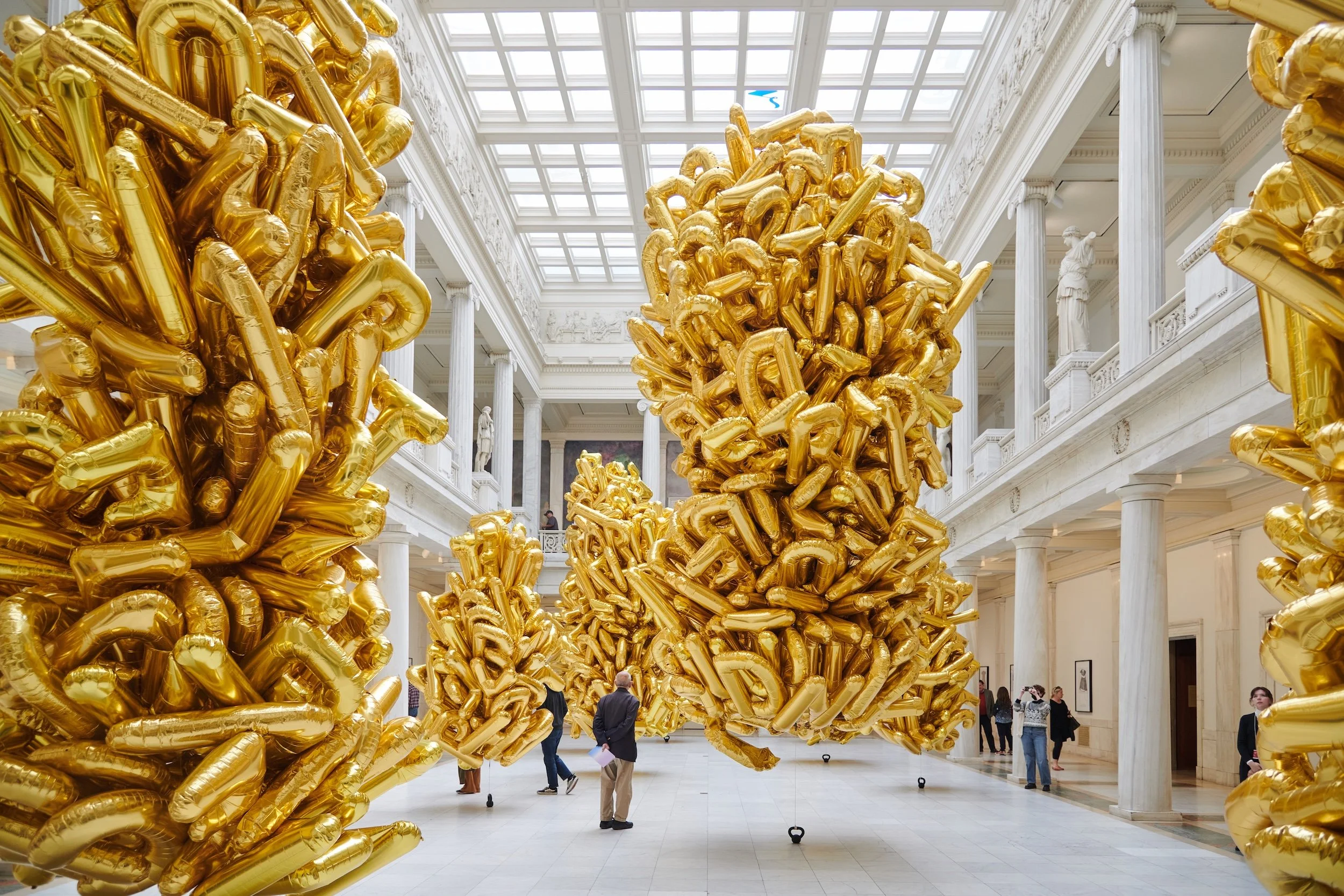
Banu Cennetoğlu: right? (2022 - ). Mylar ballons, helium, cotton cord, weight. Installation view, 58th Carnegie International, Carnegie Museum of Art, Pittsburgh, September 2022. Photo: Sean Eaton. Courtesy the artist and Sylvia Kouvali, London/Piraeus.
As we look closely at the meticulous lines of white string binding the letter balloons together, the artist explains that the UDHR’s own language falls short of its promise to protect all human beings. For example Article 22:
Everyone, as a member of society, is entitled to realization of the economic, social and cultural rights indispensable for his dignity and the free development of his personality, through national effort and international co-operation and in accordance with the organization and resources of each State.
While the rights are described as universal, the means of realizing them are national and resource-limited. The structures goverened by Articles 25 and 26 — social security, medical care, elementary education are all things a state administers for its citizens.
But what about those without a country? Cennetoğlu understands the fate of stateless people well. Her best known work The List documents names, demographic details, and circumstances of death for tens of thousands of refugees, asylum seekers, and migrants who died on the borders of Europe since 1993. Since starting in 2002, The List has grown to over 34,000 names.
“Despite the lofty declaration of rights, our international order is one that continues to produce rightlessness.”
At the point of “writing,” the work is a celebration — spectacle, glory, wow factor. This was her inverse intent, commenting that today there is not much to celebrate. The gold letters do things people cannot. They defy gravity, float in space, touch the ceiling, loom large. The artist describes her surprise at how many instagramers posted her work when it went opened at Carnegie International in 2022, and how significantly the posts declined when the work deflated. She says the bouquets eventually becomes almost monstrous. The instagram posts discontinue. The party is over, at least for the moment.
From Boston, right? will travel to Röda Sten Konsthall, Göteborg in Sweden, where the next articles will be inflated and exhibited.
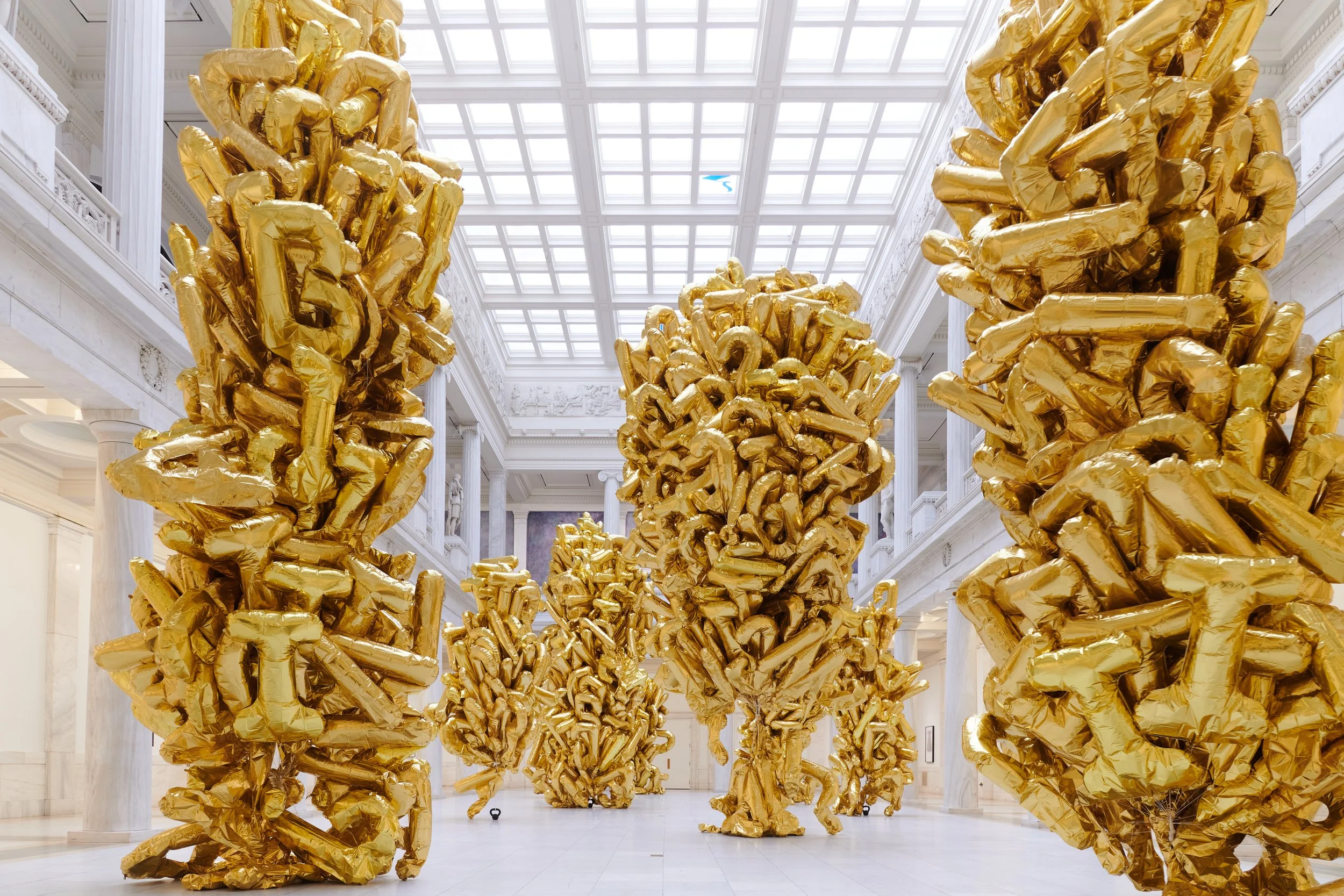
Banu Cennetoğlu: right? (2022 - ). Mylar ballons, helium, cotton cord, weight. Installation view, 58th Carnegie International, Carnegie Museum of Art, Pittsburgh, December 2022. Photo: Sean Eaton. Courtesy the artist and Sylvia Kouvali, London/Piraeus.
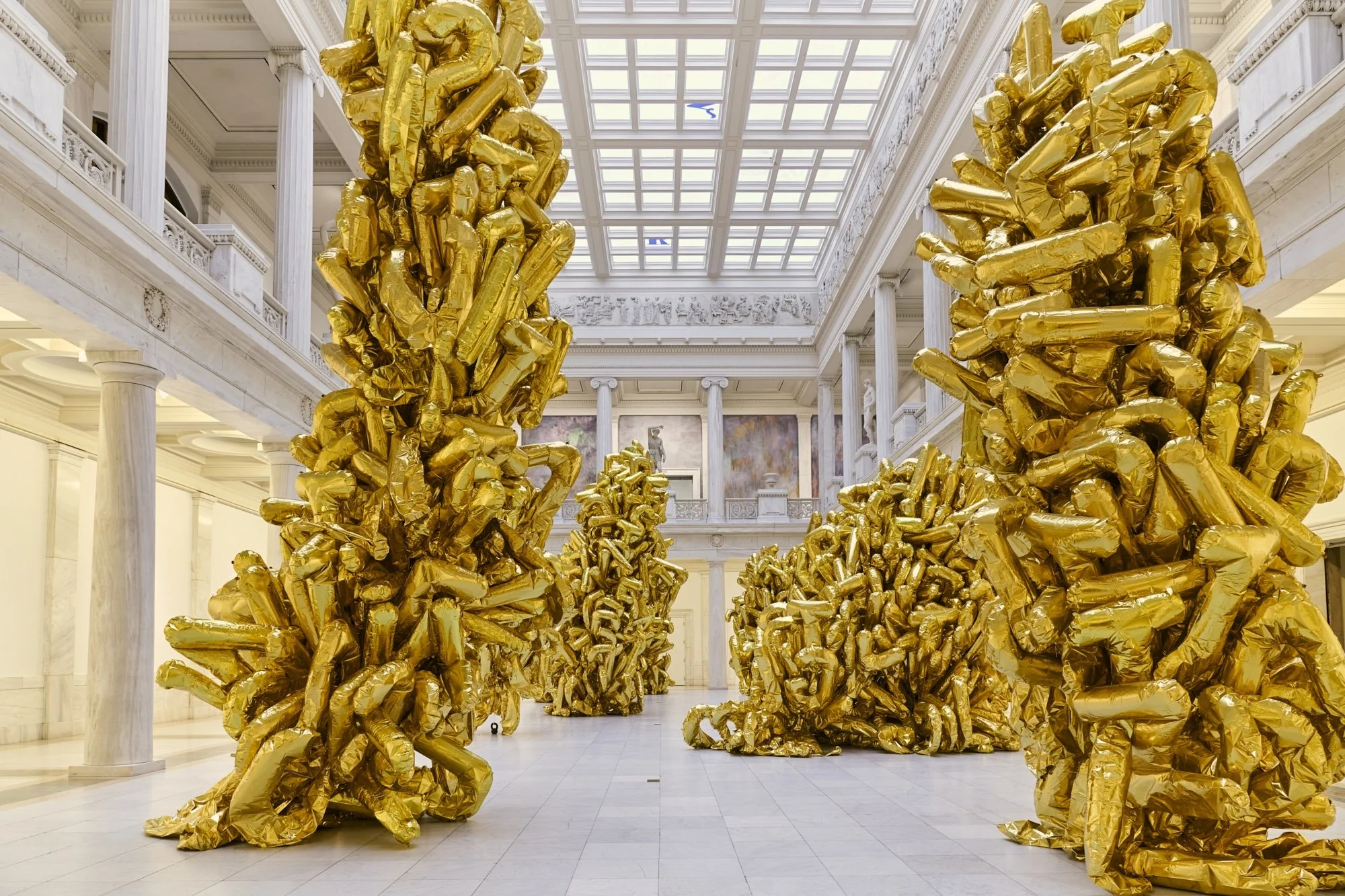
Banu Cennetoğlu: right? (2022 - ). Mylar ballons, helium, cotton cord, weight. Installation view, 58th Carnegie International, Carnegie Museum of Art, Pittsburgh, February 2022. Photo: Sean Eaton. Courtesy the artist and Sylvia Kouvali, London/Piraeus.
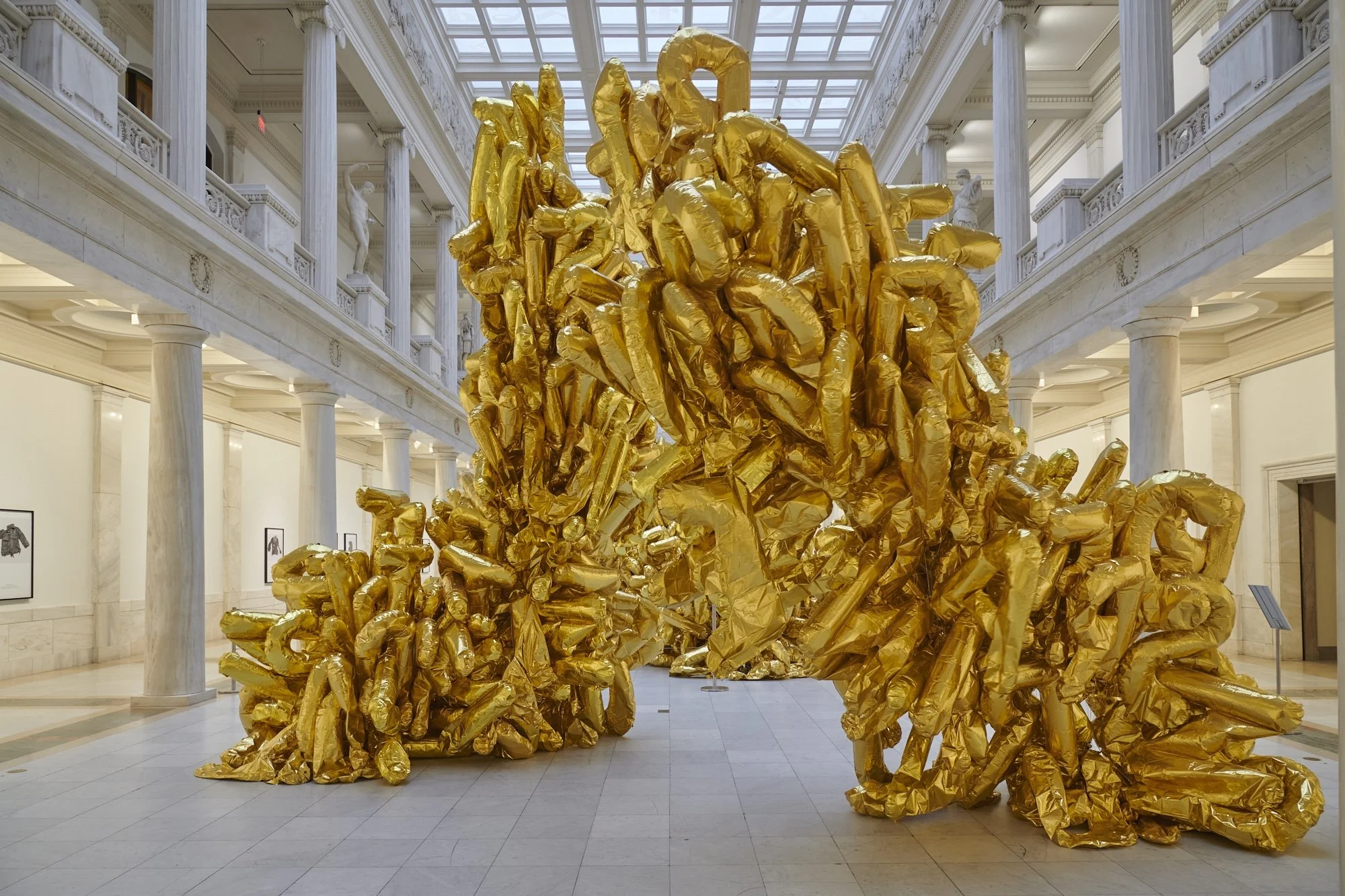
Banu Cennetoğlu: right? (2022 - ). Mylar ballons, helium, cotton cord, weight. Installation view, 58th Carnegie International, Carnegie Museum of Art, Pittsburgh, April 2022. Photo: Sean Eaton. Courtesy the artist and Sylvia Kouvali, London/Piraeus.
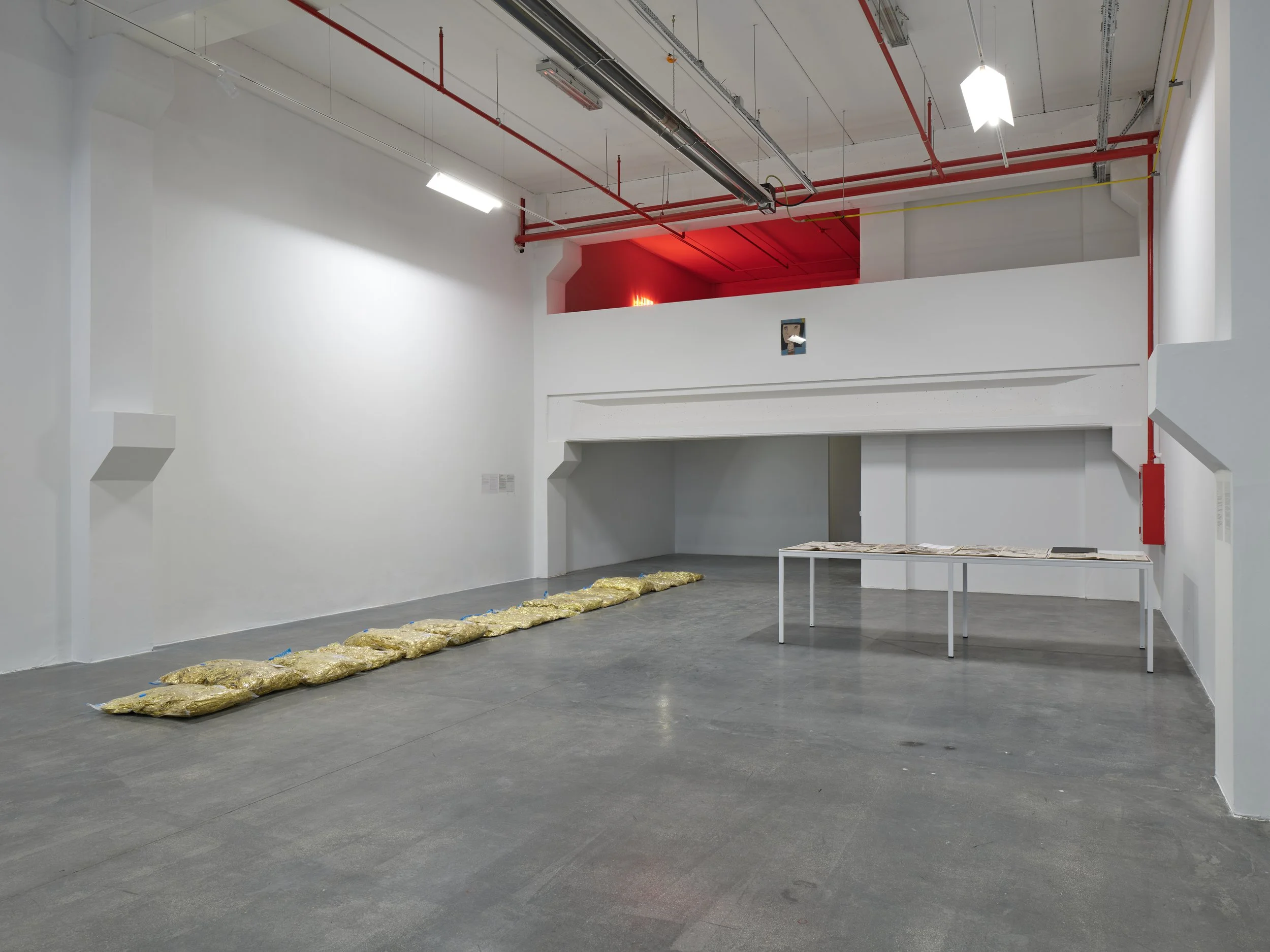
Banu Cennetoğlu: right? (2022 - ). Deflated Mylar balloons, vacuum storage bags, 58th Carnegie International wall text and promotional video. Installation view, ne karanfil ne kurbağa, Imalathane, Bursa, 2025. Photo: Barış Özçetin. Courtesy the artist and Sylvia Kouvali, London/Piraeus.
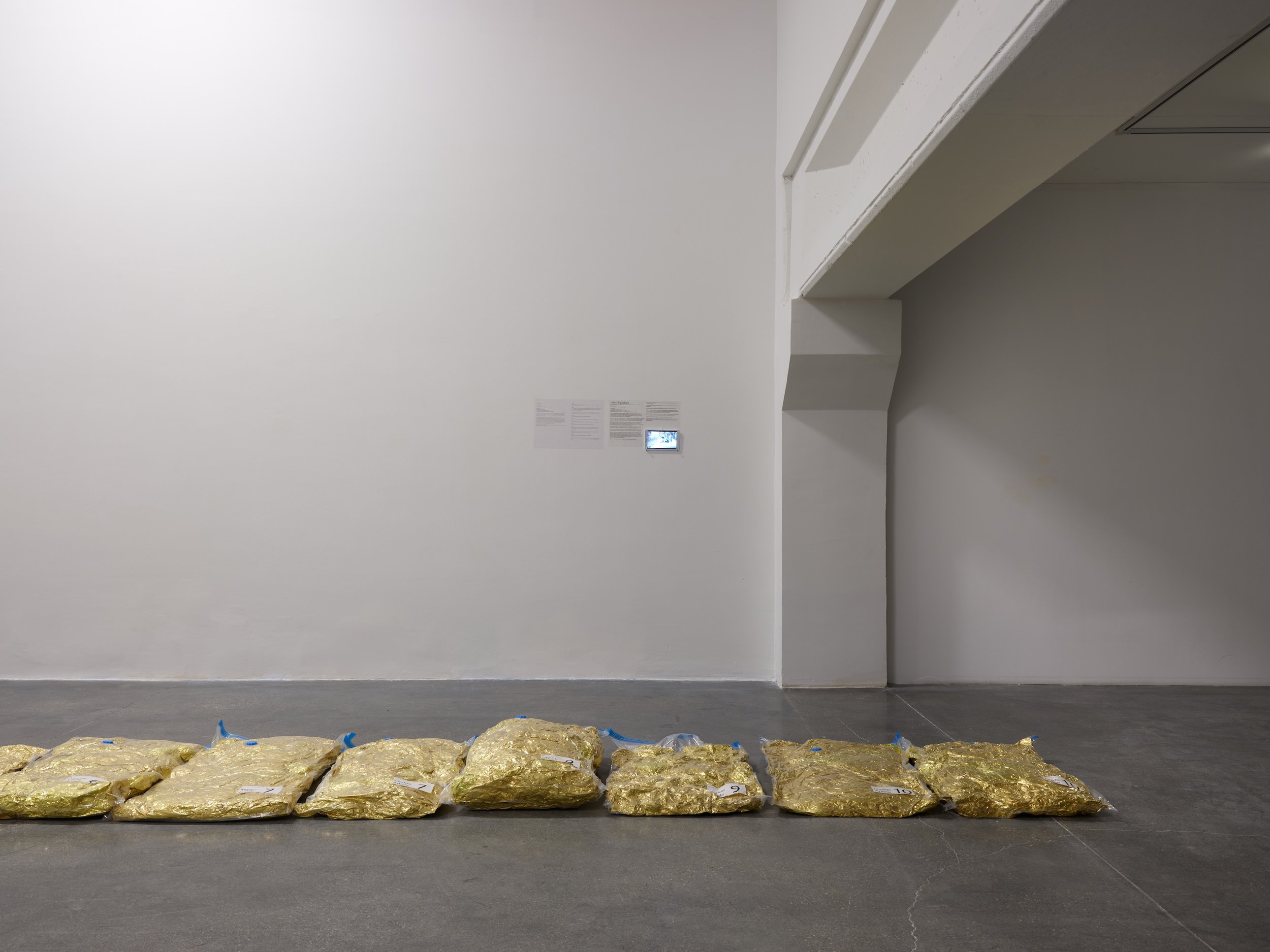
Banu Cennetoğlu: right? (2022 - ). Deflated Mylar balloons, vacuum storage bags, 58th Carnegie International wall text and promotional video. Installation view, ne karanfil ne kurbağa, Imalathane, Bursa, 2025. Photo: Barış Özçetin. Courtesy the artist and Sylvia Kouvali, London/Piraeus.
Monumental and hollow, Cennetoğlu’s word totems clamber into spaces humans can’t reach, the golden glare signaling power, money, dominance. Looming, they expand with helium pride. But a chest can only stay puffed out so long. Being balloons, the letters begin to deflate as soon as they have reached their peak height. Slowly, over time, the letters begin to bend and wrinkle, the articles fold in on themselves, and the fuller, more advantageously shaped letters crowd out and lean on the weak. After a matter of months, the balloons lie exhausted and flat on the floor, empty. The artist seals the deflated clusters in large plastic bags. Thus the articles of the UDHR become two dimensional once again, and we are left to consider their meanings, both as spectacle and as spent performance.
MassArt Art Museum (MAAM)
621 Huntington Avenue, Boston, MA 02115
Always free. Open Wednesday and Friday from 12:00 PM to 6:00 PM, Thursday from 12:00 PM to 8:00 PM, and Saturday and Sunday from 10:00 AM to 6:00 PM (closed Monday and Tuesday).