Ninety Years a Renegade: The ICA Looks Back
This month the ICA Boston turns 90, an astonishing milestone for the institution described as a “renegade offspring of the Museum of Modern Art” when it was incorporated as the Boston Museum of Modern Art in October, 1936.
The museum-wide celebration that includes the retrospective exhibition 90 YEARS, installations of collection highlights on every floor, and a special performance season featuring Bill T. Jones/Arnie Zane Company and a reimagining of Andy Warhol and the Velvet Underground's Exploding Plastic Inevitable, serves as reminder and deepening of the museum’s iconoclastic roots.
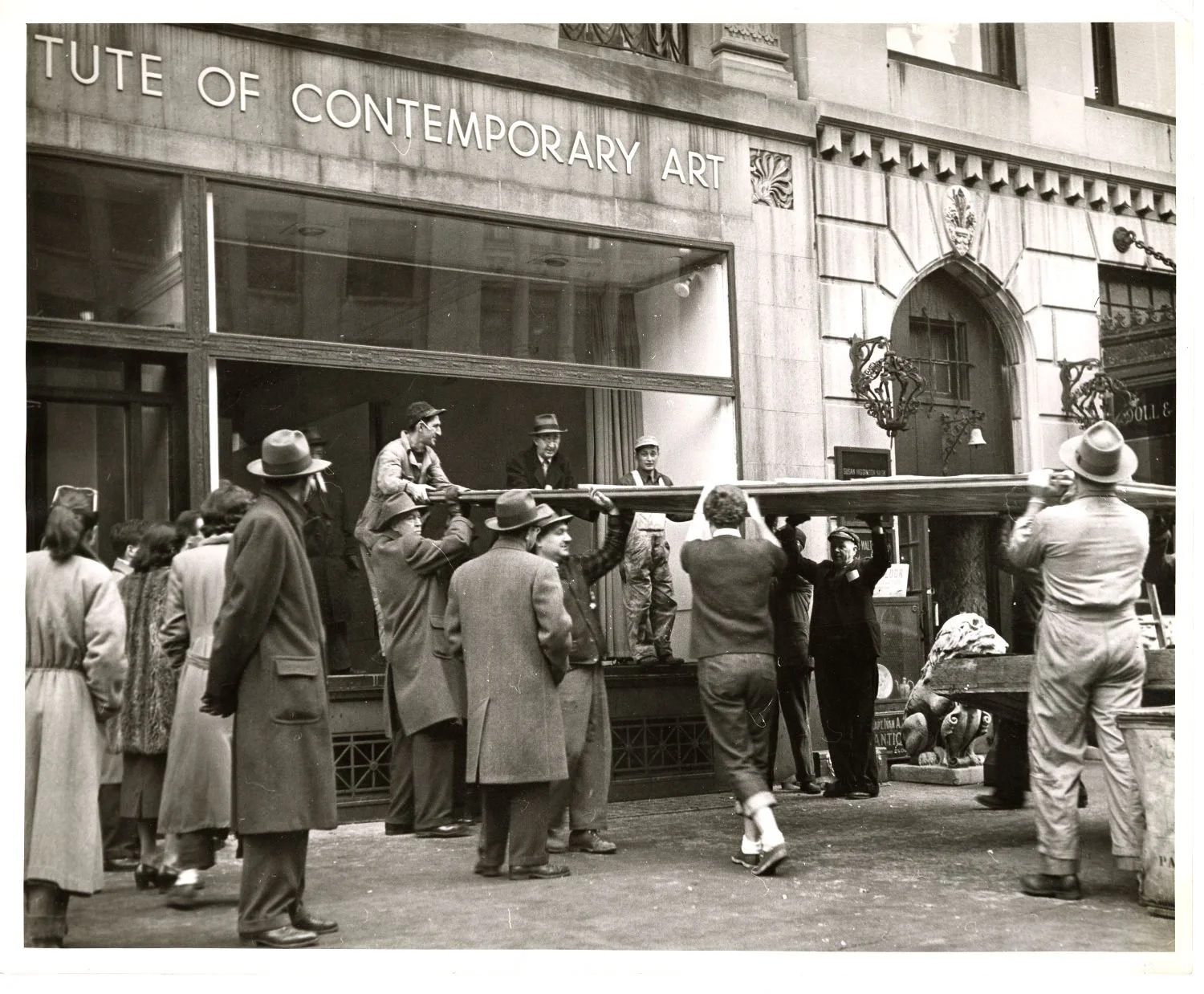
An image from the ICA’s recently accessible archives. Courtesy of the ICA Boston.
The ICA is Boston’s cultural mighty-engine-that-could; one of the country's first museums dedicated to contemporary art, beloved for taking risks, committed to showing art by women and other underrepresented populations, and only recently settled in a permanent home of its own. A community hub that distributed food and art activities during the pandemic, held naturalization ceremonies for immigrants, maintains a dedicated teen program space, and practices institutional silo-busting by collaborating with fellow museums and nonprofits, the ICA models how to serve up art exhibition as nutrition to a public hungry for creative, spiritual and neighborly sustenance.
These qualities — the ICA DNA as it were — didn’t appear out of nowhere. They developed as a result of the institution's unconventional and dramatic 90 year history.
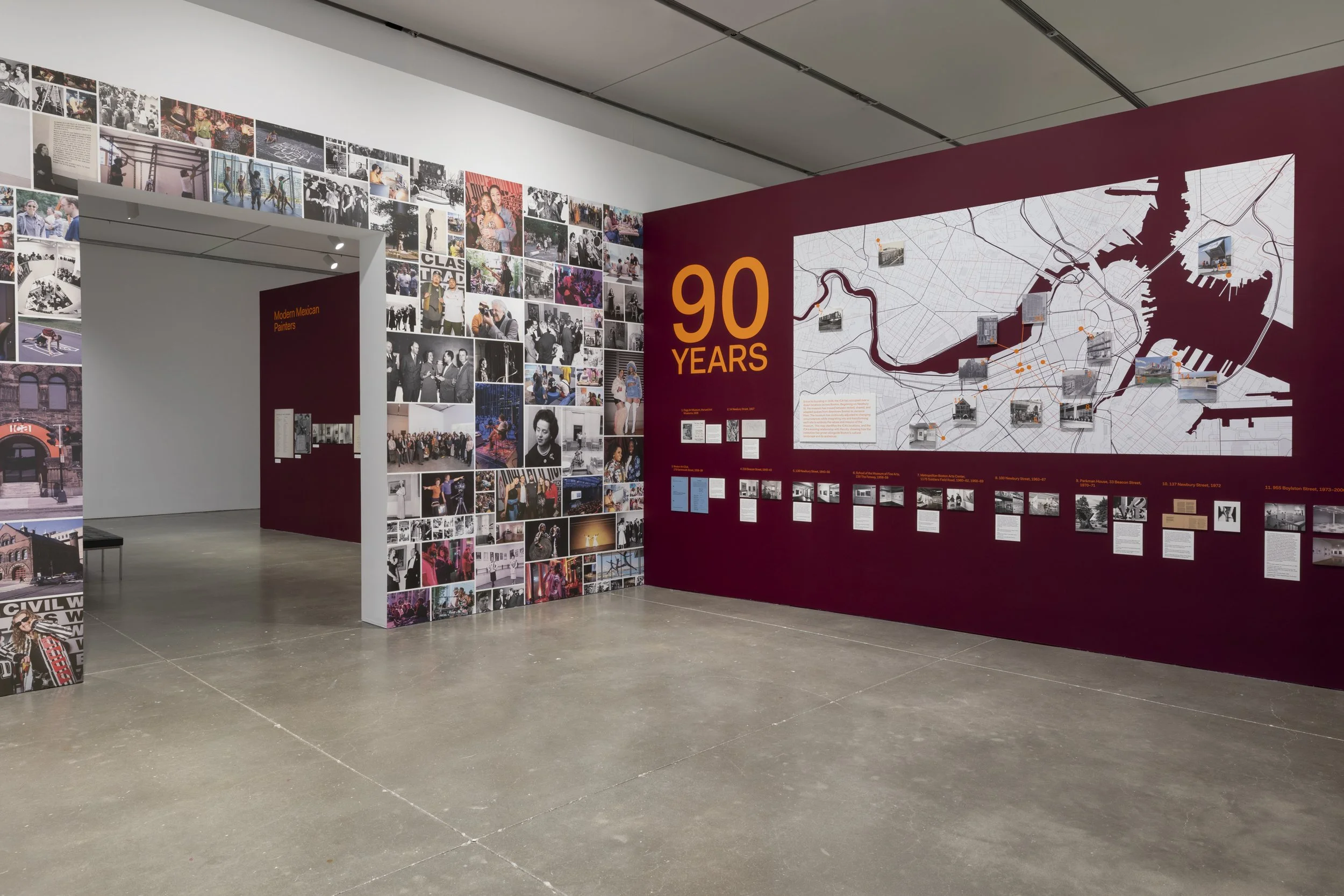
The opening gallery of 90 YEARS features a map showing the 13 different locations of the ICA Boston through the years. Photo Mel Taing.
Like a friend giving a birthday toast, the ICA knew their anniversary exhibition could not and should not include everything. 90 YEARS is not a catalog, but a selection. Nobody giving a 90th birthday toast attempts to cover all ninety years. They choose key stories from different decades, and tell them well enough that people listening can imagine the whole life behind them. The ICA Curatorial team — Ruth Erickson, Jeffrey De Blois, Erika Umali, Tess Bachi Hass, and Max Gruber — chose one pivotal exhibition for each decade and reimagined them in depth so that the nine mini-shows together reveal the ICA’s life story to date.
90 YEARS opens in a gallery dedicated to mapping the museum’s physical history and exhibiting key pieces from the archives, organized after decades of inaccessibility thanks to a grant from the Barr Foundation. Founded by a group that met at Harvard, what was then called the Museum of Modern Art opened on October 30th, 1936 as a sister institution to MoMA and without a building of its own. Its first exhibition, a survey of Paul Gauguin, took place in space leased from the Fogg Art Museum. The ICA moved an astonishing 13 times before landing in the Seaport in 2006, which explains both why the archives were inaccessible for so many decades and why its current home is significant. The Diller Scofidio + Renfro building, overseen by longtime director Jill Medvedow, also marked the beginning of the museum's collection, after 70 years as a non-collecting institution.
Ruth Erickson, Barbara Lee Chief Curator and Director of Curatorial Affairs, defines the museum’s founding question as, what is the meaning of the art of our time? "The answers to that question are myriad and ever-changing," Erickson said during a tour of the show, "like the dynamic city of Boston, the world, and the global art world at large."
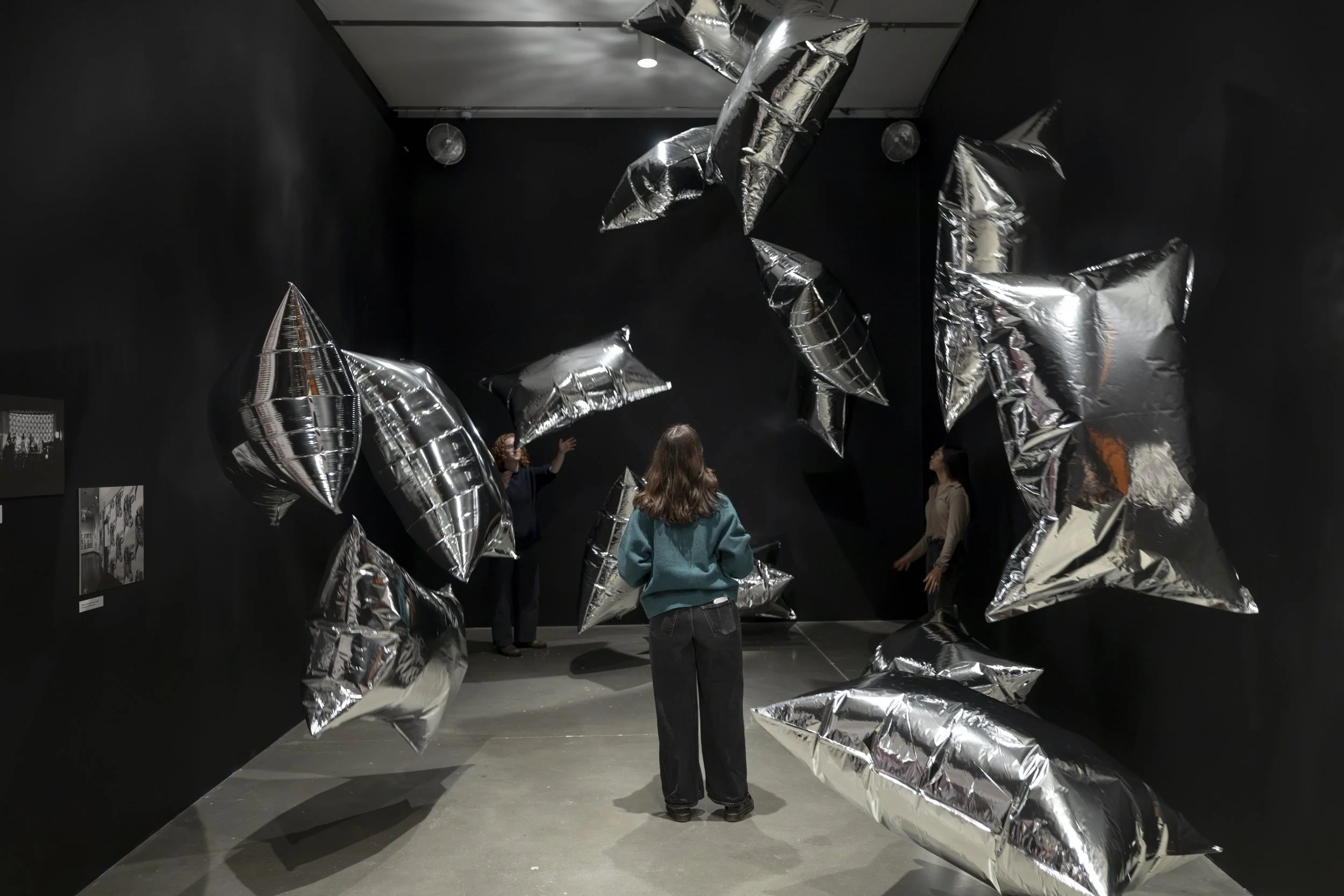
Andy Warhol, Facsimile of Silver Clouds1966/2026. Mylar filled with helium. Twenty parts, each 32×48×15 inches (81.3×121.9×38.1 cm). Refabricated by The Andy Warhol Museum, Pittsburgh ©The Andy Warhol Foundation for the Visual Arts, Photo Mel Taing.
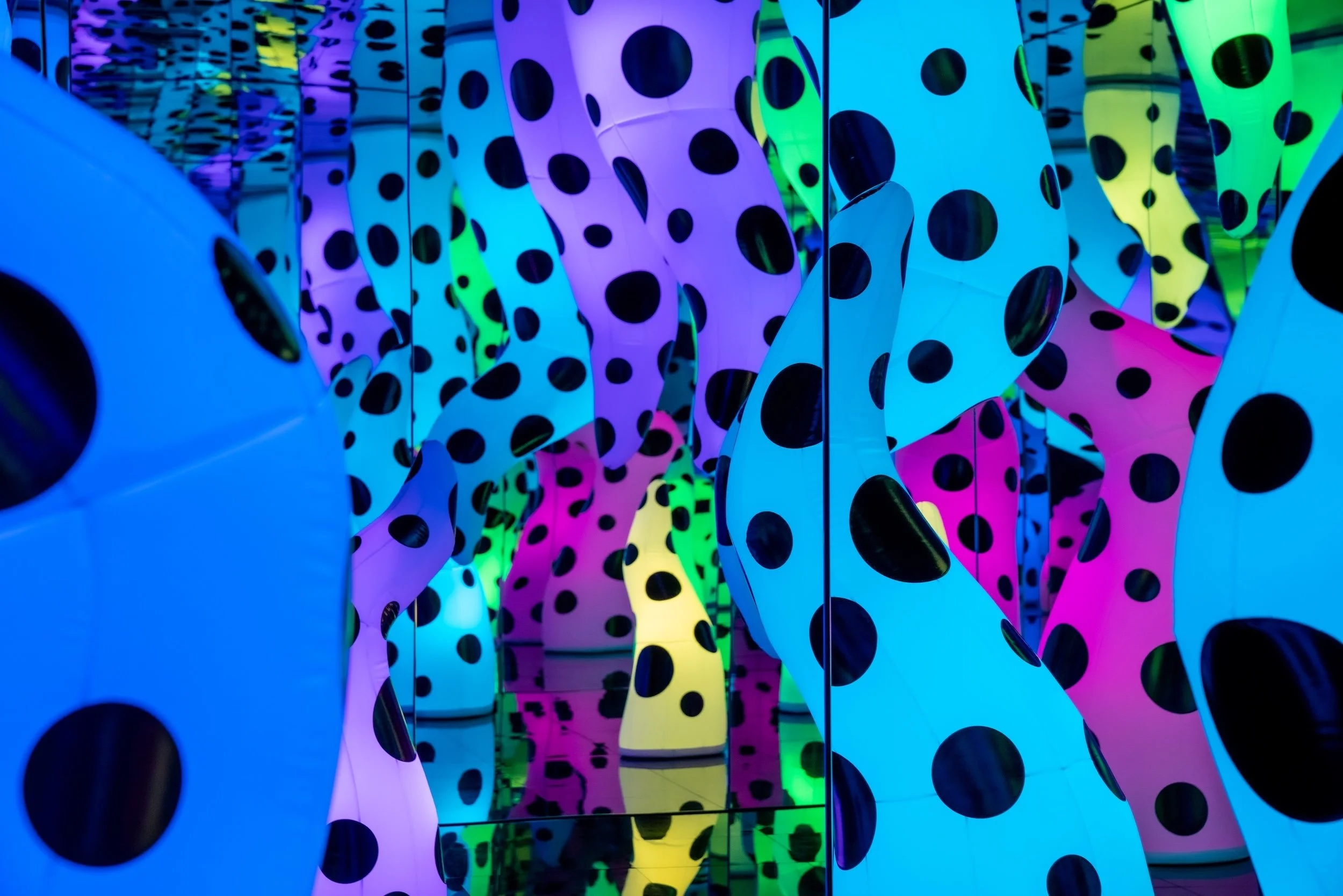
The show is expansive and full of surprises. Don’t miss the return of Yayoi Kusama’s Infinity Room Love is Calling and Andy Warhol’s Silver Clouds, created in his famous studio, the Factory. Here are some additional highlights:
1940s — MODERN MEXICAN PAINTERS (1941)
Modern Mexican Painters (1941) was an early example of the museum's determination to promote an expanded view of modernism beyond the Eurocentric view taught in art academies. Curatorial assistant Max Gruber explained that the included artists drew on Mesoamerican and folk traditions while absorbing modernism on trips to Europe and New York. "A lot of audiences in the United States thought Mexican painters made murals about revolutionary politics," he said. "But we can see here that there are actually lots of different styles of painting."
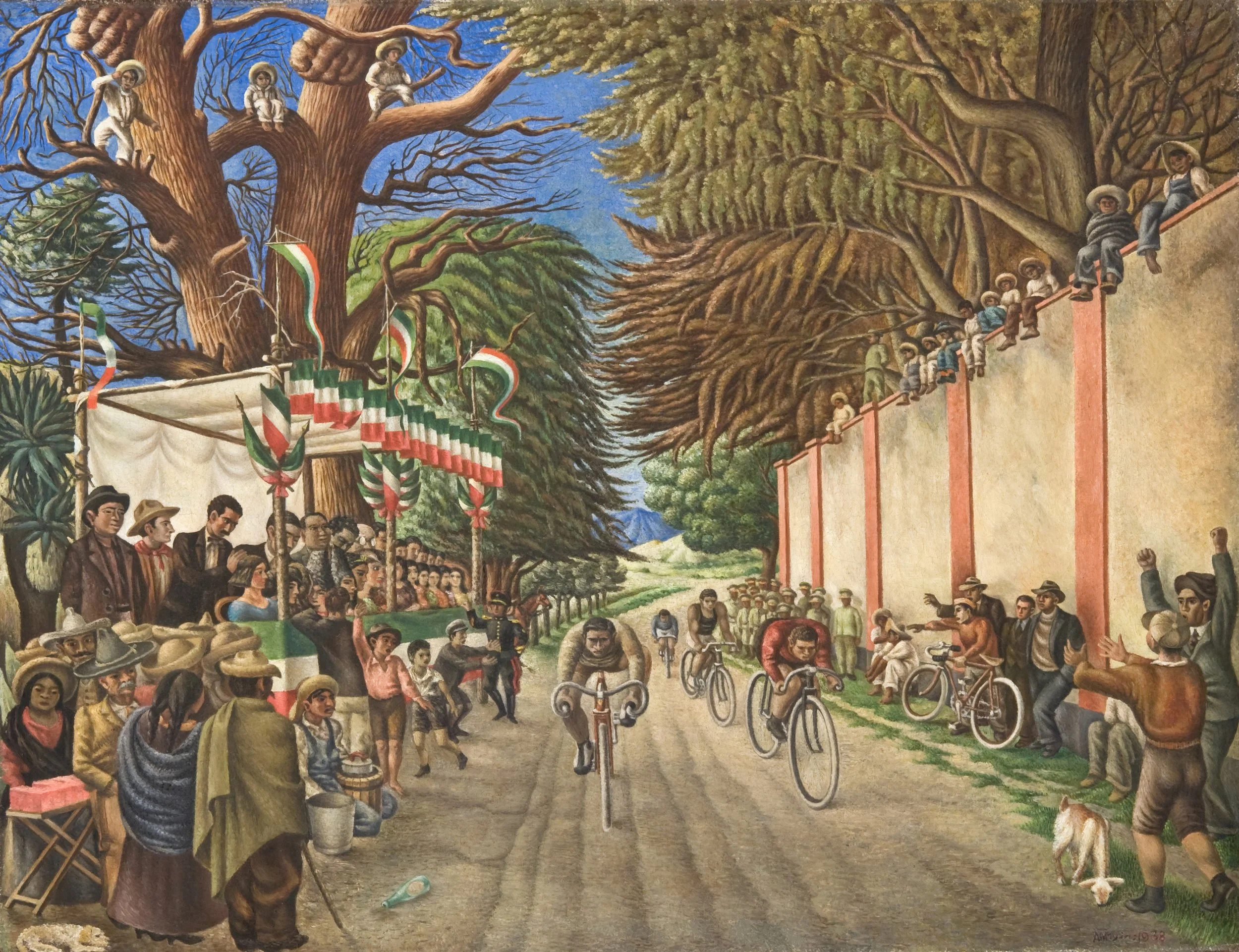
Antonio Ruiz, Bicycle Race, 1938. Oil on canvas. Philadelphia Art Museum. Purchased with the Nebinger Fund, 1949.
"There's a real sense that Europe need not be the only model for thinking about the modernisms that were emerging," Erickson explained. This expanded modernism becomes a key theme of the exhibition, seen later in the work of Ellen Gallagher and Simone Leigh.
1950s — DESIGN IN INDUSTRY / CLARISSA TOSSIN
In the fifties the ICA launched a Department of Design in Industry, what Assistant Curator Tessa Bachi Haas described as “a consultation service pairing predominantly New England–based manufacturers with designers, intended to improve the aesthetics and functionality of everyday objects.” In 1952 the Design in Industry exhibition celebrated five years of these collaborations. The exhibitions were aimed at consumers, particularly women. Don’t miss some of the museum’s promotional materials — they read like magazine advertisements.
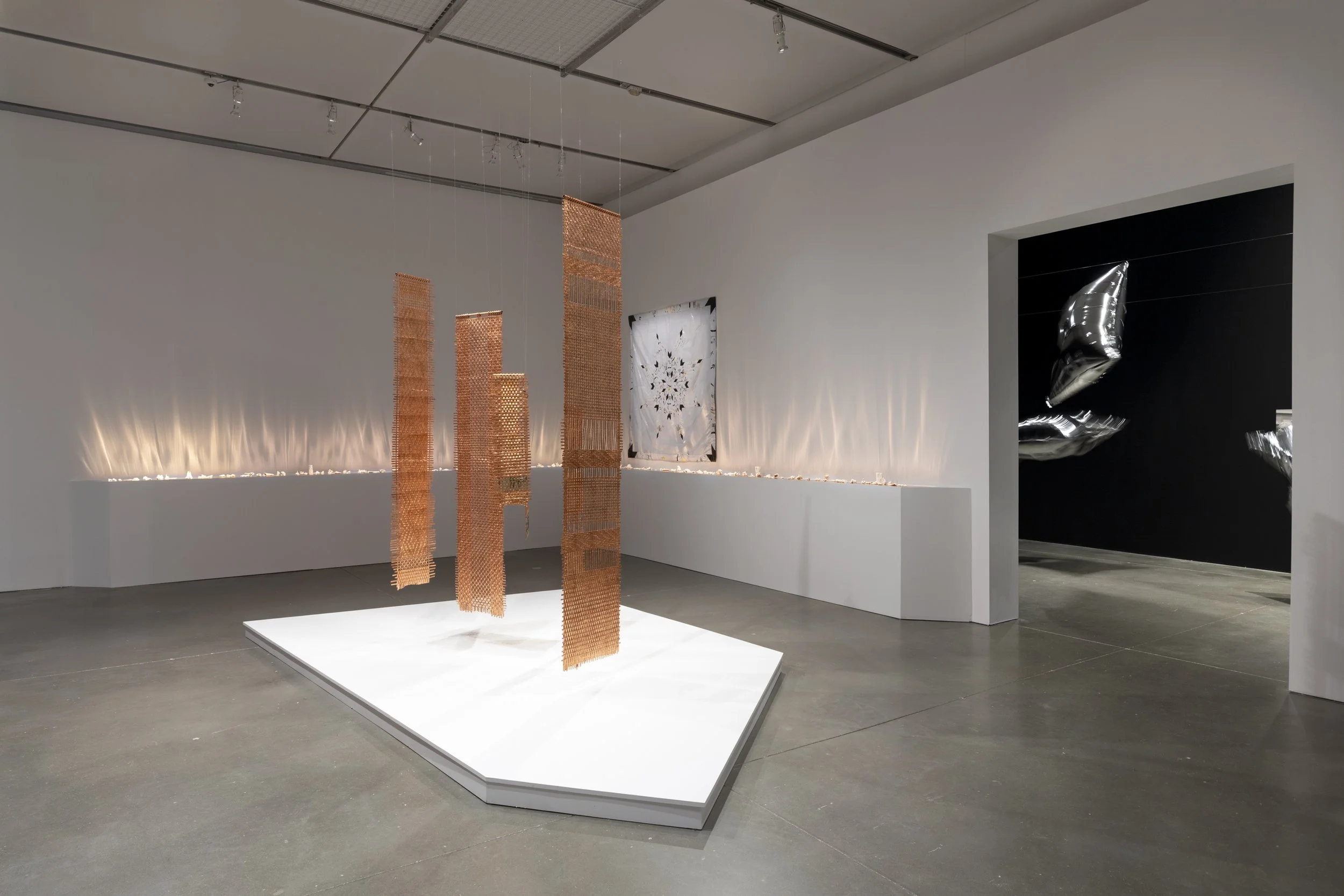
Installation view, Clarissa Tossin, the Institute of Contemporary Art/Boston, 2026-27. Photo byMel Taing.
The curators did not restage this exhibition. They commissioned a contemporary artist — Brazilian-born, Los Angeles-based artist Clarissa Tossin, whose work traces how materials circulate through global systems of extraction, trade and consumption — to create work that speaks to the theme of consumerism and trade in the current moment. (You may remember Tossin’s work from MAAM’s show Future Fossils). For the commission, Tossin wove recycled Amazon boxes into geometric patterns and covered them by hand in layers of copper leaf. Copper is a material loaded with meaning, essential to everything from iPhones to wind turbines. It is mined largely in the Global South, including the artist’s home country Brazil. Bringing together "the two Amazons, the rainforest and the corporation," the work draws our attention to the waste and climate impact of global consumerism.
1980s — THE CONTEMPORARY ART TELEVISION (CAT) FUND
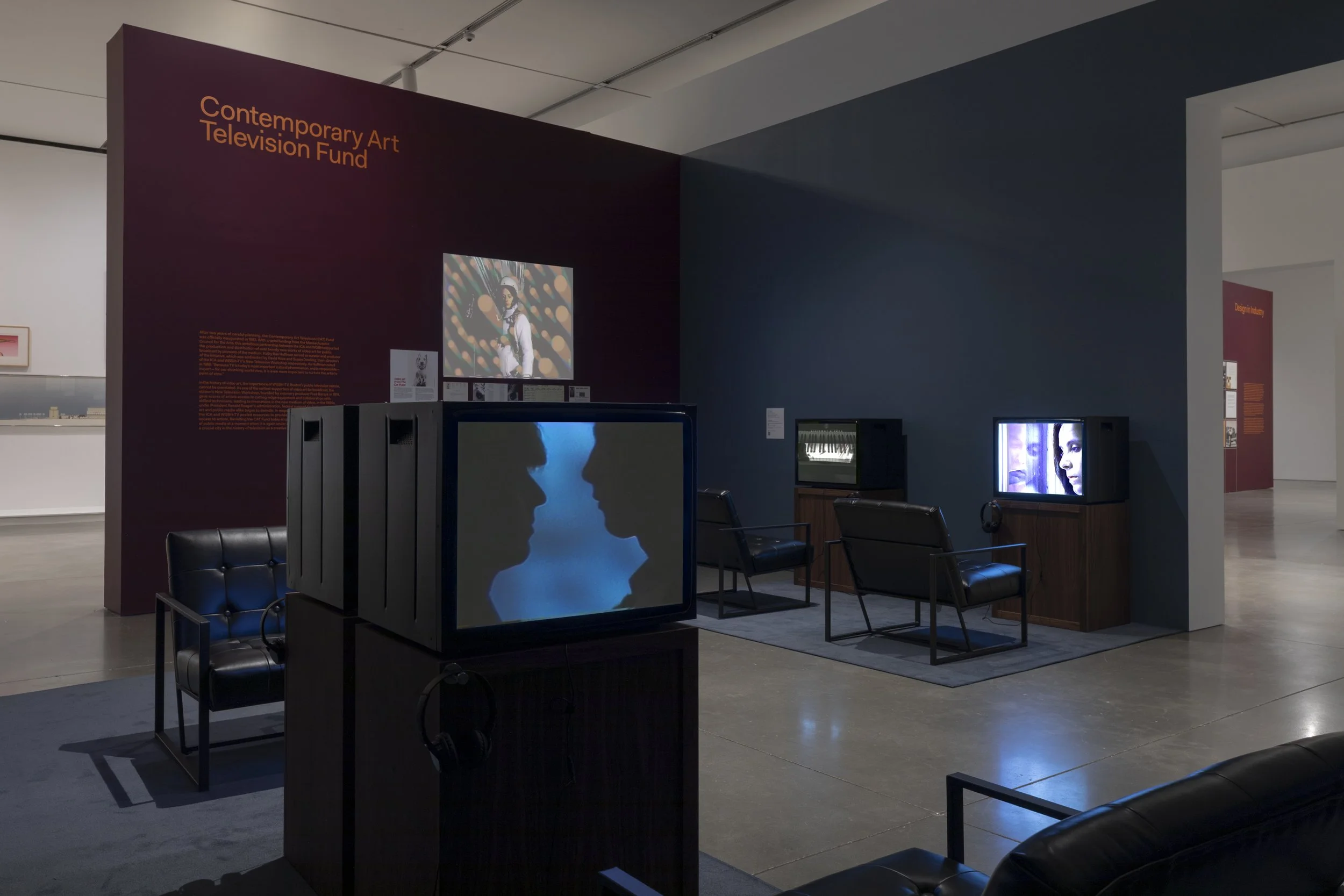
Installation view, the CAT Fund, 90 YEARS, the Institute of Contemporary Art/Boston, 2026-27. Photo by Mel Taing.
Designed with chairs and antiquated monitors to magnify the home viewing experience, the 1980s gallery showcases the CAT Fund. This unique collaboration between the ICA and WGBH supported a cohort of video artists rethinking video for intimate viewing at home. It grew out of WGBH's New Television Workshop, an artist residency founded in 1967, and was championed by David Ross, the world's first video art curator, who arrived at the ICA in 1982 as Reagan-era funding threatened public media and experimental art. The fund produced more than 20 works, including Joan Jonas's Double Lunar Dogs, a post-apocalyptic tale aboard a drifting spaceship whose travelers have forgotten their mission.
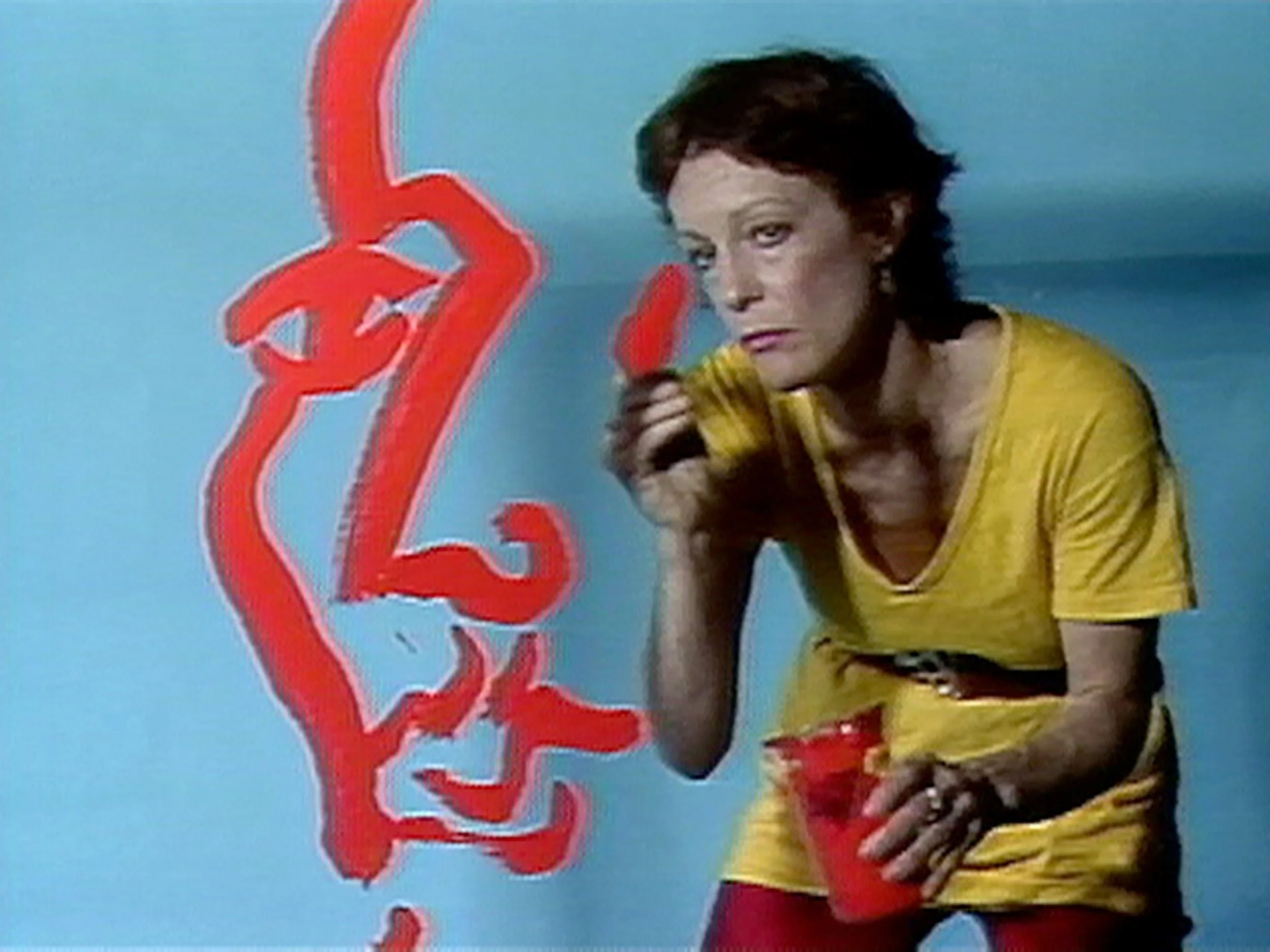
Joan Jonas, Double Lunar Dogs, 1984. Single channel video (color, sound) 24:04 minutes. Courtesy of Electric Arts Intermix, New York.
2000s — ELLEN GALLAGHER: WATERY ECSTATIC (2001)
Women artists are the superheroes of the ICA legacy. Thanks to visionary leadership at the board and institutional level, solo shows by women made up a big part of the programming in the 2000s. Ellen Gallagher’s Watery Ecstatic, curated by Jessica Morgan (who was just named curator of the Tate) was a pivotal show in the artist’s trajectory. A handwritten 1994 artist statement from the archive describes Gallagher's view of the disembodied lips and eyes of minstrelsy as a form of abstraction. Doll's Eyes (1992) reads as abstract from afar, until the eyes stare back up close. Watery Estatic, built on what would become her signature penmanship paper, shows the leap in scale she made for her ICA debut. Gallagher was among the first artists to explore Drexciya, the Detroit techno myth of an underwater civilization born of pregnant enslaved women thrown overboard during the Middle Passage, a subject later taken up by ICA-exhibited artists Firelei Báez and Tau Lewis.
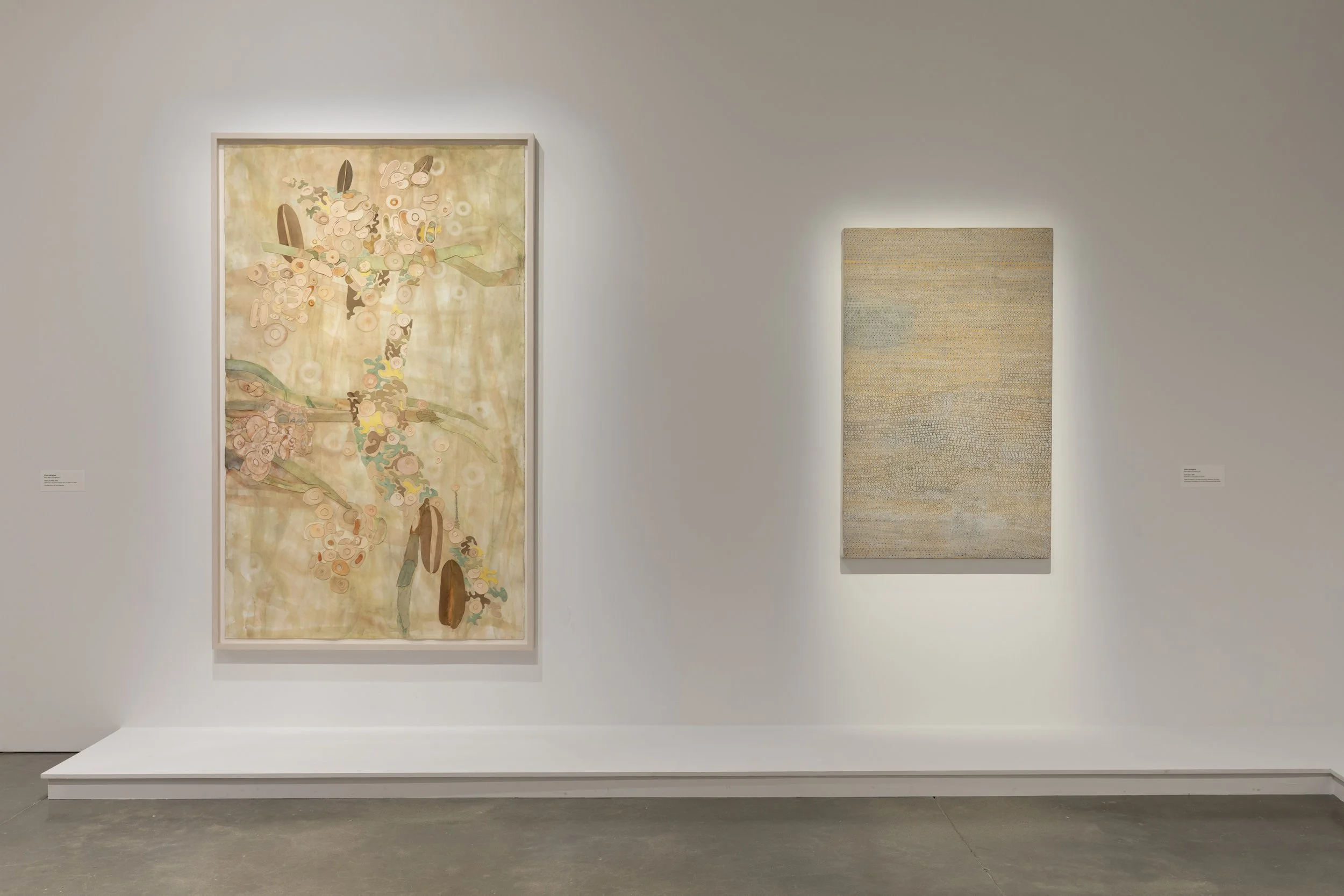
Ellen Gallagher, Watery Estactic, 2018 (left) and Dolls Eyes, 1992 (right). Installation view, the CAT Fund, 90 YEARS, the Institute of Contemporary Art/Boston, 2026-27. Photo by Mel Taing.
2010s–2020s — SIMONE LEIGH
While the ICA’s history reads like an adventure story, full of physical upheavals and daring creative leaps, the recent years represent a new chapter of global influence. This was never more apparent than at the 2022 Venice Biennale, where the museum, led by Director Jill Medvedow and Eva Respini, then the ICA’s Deputy Director and Barbara Lee Chief Curator, commissioned the first Black woman ever to represent the United States in Venice — Simone Leigh. Her show Sovereignty was an unforgettable investigation of Black femininity and the female body "as a place of care, a place of home, and also a body of resilience." That same year she won the Golden Lion for her work in the Biennale’s main international exhibition.
Cupboard IX, the ICA's first Leigh acquisition (2019), replaces a figure's face with a vessel and sets it on a raffia skirt shaped like both a dwelling and a Mississippi restaurant built on the "mammy" stereotype. Jug riffs on the face jugs made by enslaved potters in Edgefield, South Carolina, substituting cowrie shells for a face. In 2022 the ICA commissioned Leigh for the US Pavilion at the Venice Biennale, acquired a work from it, and toured the presentation to the Hirshhorn and to LACMA and the California African American Museum.
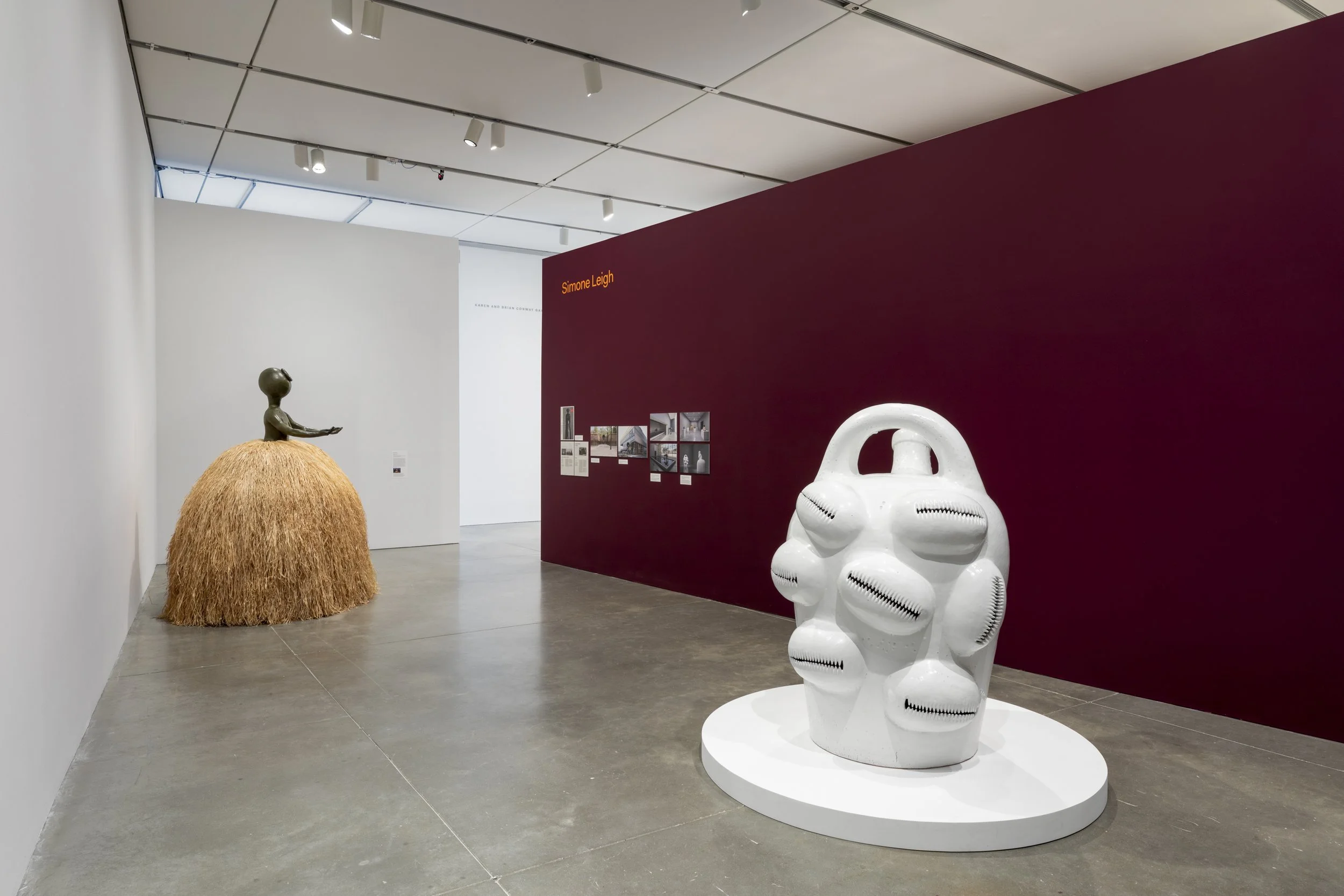
Simone Leigh, Cupboard IX, 2019 (left) and Jug, 2022, (right). Installation view, the CAT Fund, 90 YEARS, the Institute of Contemporary Art/Boston, 2026-27. Photo by Mel Taing.
Given its wide lens, 90 YEARS will leave some visitors wanting more or missing favorites. It’s inevitable given the number of firsts and daring exhibitions the ICA mounted through the years: the first Paul Gauguin survey in Boston (1936), Frank Lloyd Wright’s first US museum survey (1940), first survey of African American artists in New England, including Romare Bearden and Jacob Lawrence (1943), first US museum exhibitions of Sophie Calle (1990), Cornelia Parker (2000), and Tara Donovan (2008). I would have been thrilled to see Ragnar Kjartansson's The Visitors (2012), even while I agree that Yayoi Kusama's LOVE IS CALLING (acquired in 2018) better fits the focus on shows and initiatives that expanded the canon. If only the show could have found a place to highlight past Foster Prize winners, the ICA's longest-running commitment to Boston artists. But no exhibition can hold ninety years in entirety.
What I found most exciting about 90 YEARS is its thematic throughline: the museum has stayed true over nine decades to its earliest renegade roots. Still showing emerging artists breaking rules (Leilah Babirye is a current case in point), and inviting the public in to think about art and the world through unique lenses, the museum anchors itself in the city of Boston, ready to lead cultural conversations for the next ninety years.
Performance
The ICA is hosting a series of performances that celebrate or reinvent moments from the ICA’s history.
Bill T. Jones/Arnie Zane Company: Collage Revisited and Story/
Friday, Nov. 20, 2026 | 8 PM
Saturday, Nov. 21, 2026 | 8 PM
Sunday, Nov. 22, 2026 | 2 PM
The Bill T. Jones/Arnie Zane Company return to the ICA with a program reflecting on history, legacy, and continued experimentation, re-visiting The History of Collage, the last collaboration between Bill T. Jones and Arnie Zane before Arnie’s death in Collage Revisited.
The Inevitable Return: Exploding Plastic Revisited
Friday, Dec. 11, 2026 | 7–11 PM
On Saturday October 29, 1966, the ICA hosted a groundbreaking multimedia performance by Andy Warhol and the Velvet Underground, under the enigmatic title, “Exploding Plastic Inevitable.” On the occasion of its 60th anniversary, the ICA resurrects the spirit of what has been called one of the greatest concerts in Boston history.
Andrew Schneider: NOWISWHENWEARE (the stars)
Thursday, Jan. 21 through Sunday, Jan. 24, 2027
Thursday, Jan. 28 through Sunday, Jan. 31, 2027
With nearly 4,000 reactive LED lights and a 496-channel sound system, NOWISWHENWEARE (the stars) traces every decision you have ever made as a contributing factor to being “here” and being “now.” The experience dazzles with light and sound while inviting contemplation on time, memory, and presence — an unforgettable way to visit the stars without ever leaving Earth. Duration varies and may run up to an hour.
Cover Image: Yayoi Kusama, LOVE IS CALLING, 2013. Wood, metal, mirrored glass, vinyl, ceramic tile, acrylic panel, blowers, lighting elements, speakers, and sound, 174 1/2 x 3405/8 x 239 3/8 inches. Acquired through the generosity of Barbara Lee/The Barbara LeeCollection of Art by Women; Fotene Demoulas and Tom Coté; Hilary and Geoffrey Grove; Vivien and Alan Hassenfeld; Jodi and Hal Hess; Barbara H. Lloyd; and an anonymous donor. Courtesy David Zwirner, New York; Ota Fine Arts, Tokyo/Singapore/Shanghai; Victoria Miro, London/Venice. Photo by Ernesto Galan.©YAYOI KUSAMA.