Radical Softness: How Janet Echelman Fills the Sky with Hope
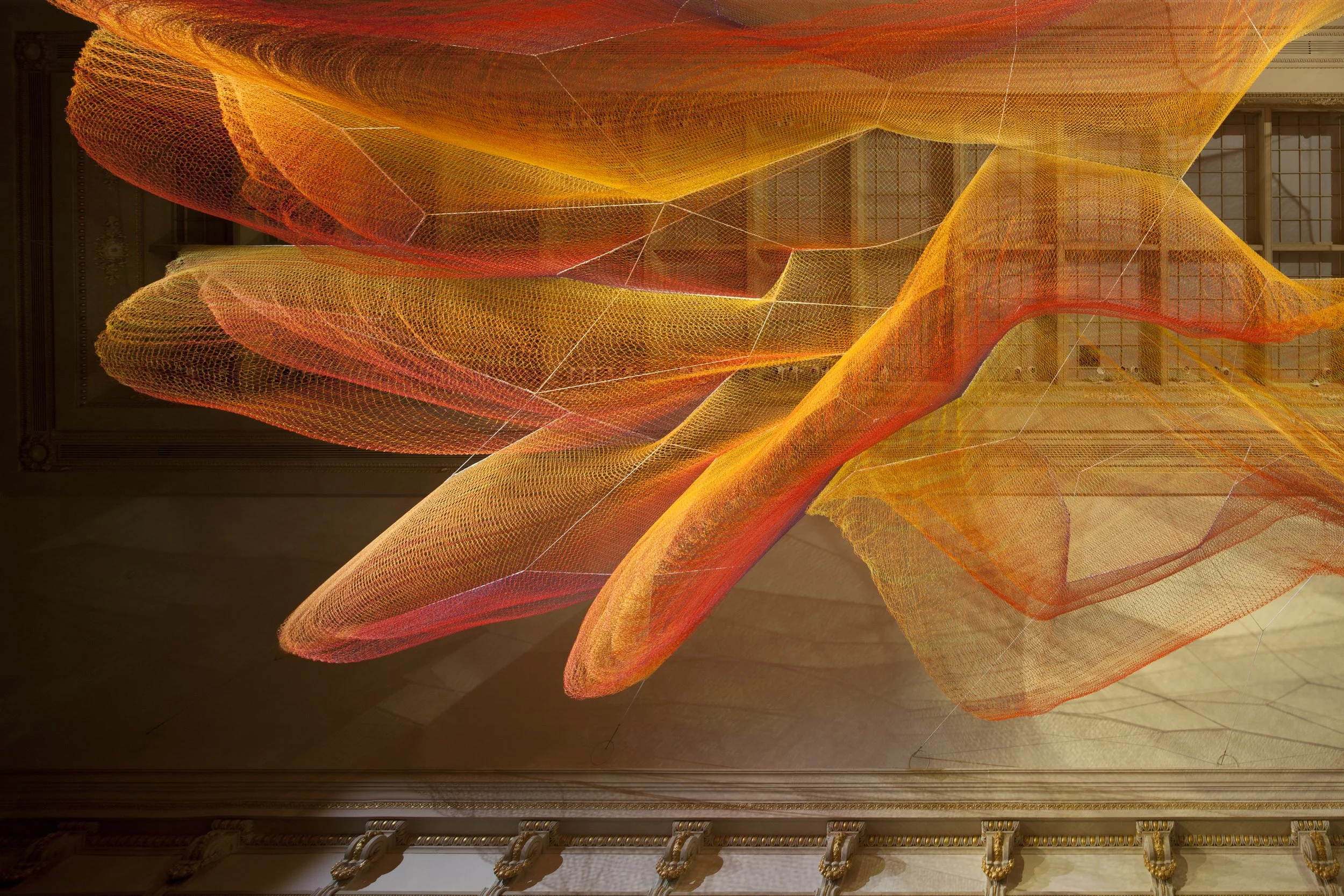
Janet Echelman's site-specific installations transform places people bypass into those they seek out and remember. Like cosmic games of cat’s cradle, her works reveal the strength in softness—of allowing, of flow, of cooperation and patience. At a time when faith is faltering and social isolation threatens more and more people’s mental health, Echelman’s public artworks offer the comforting suggestion of a power greater than ourselves.
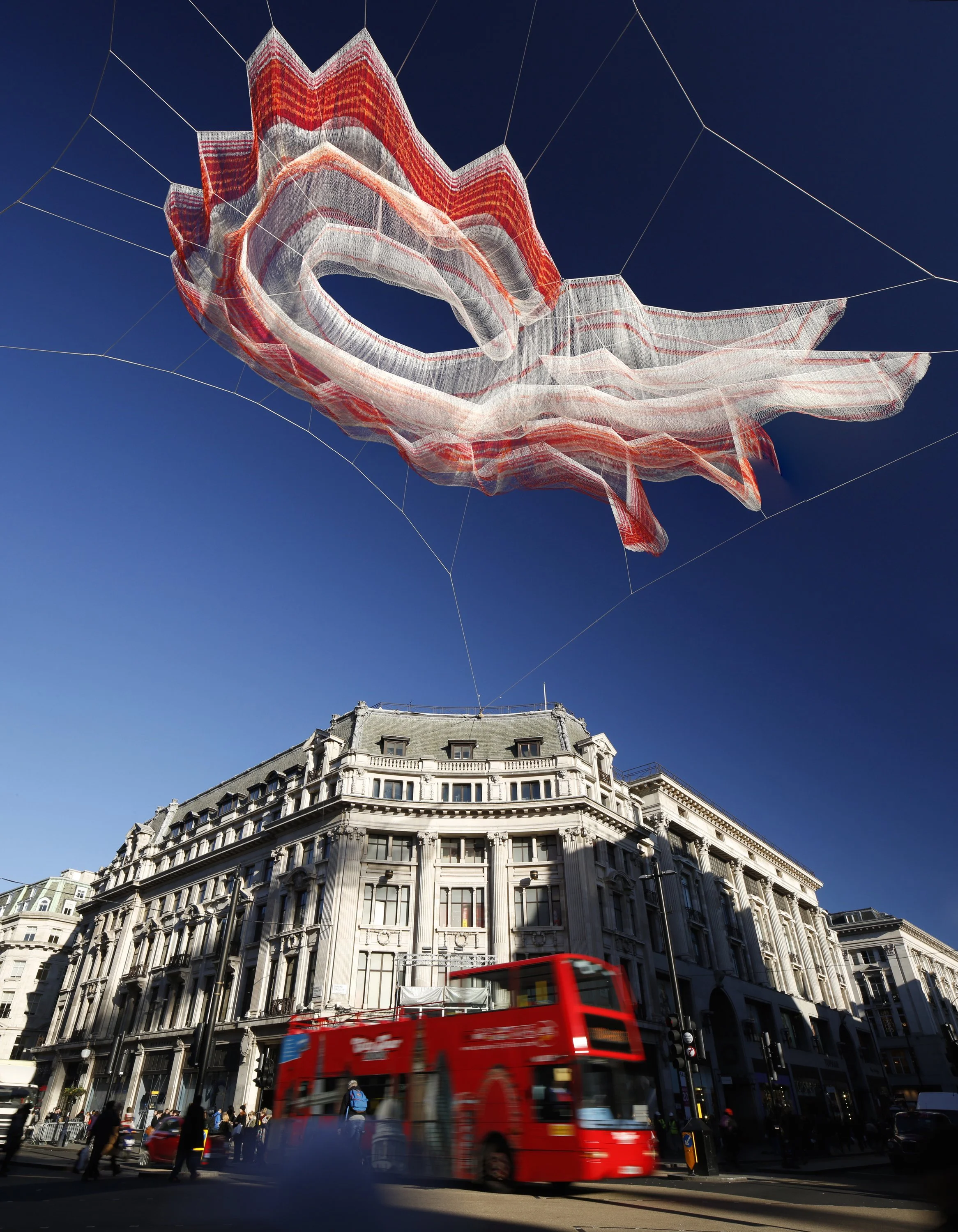
Janet Echelman Earthtime 1.8 London, UK, 2016. London Photo Ema Peter.
I met Echelman at her studio last month, on the occasion of her solo exhibition Radical Softness opening this month at the Tephra Institute of Contemporary Art in Reston, VA. Exploring four decades of work, Radical Softness offers an intimate view of the experimentation, labor, and innovation that laid the groundwork for her monumental public sculptures.
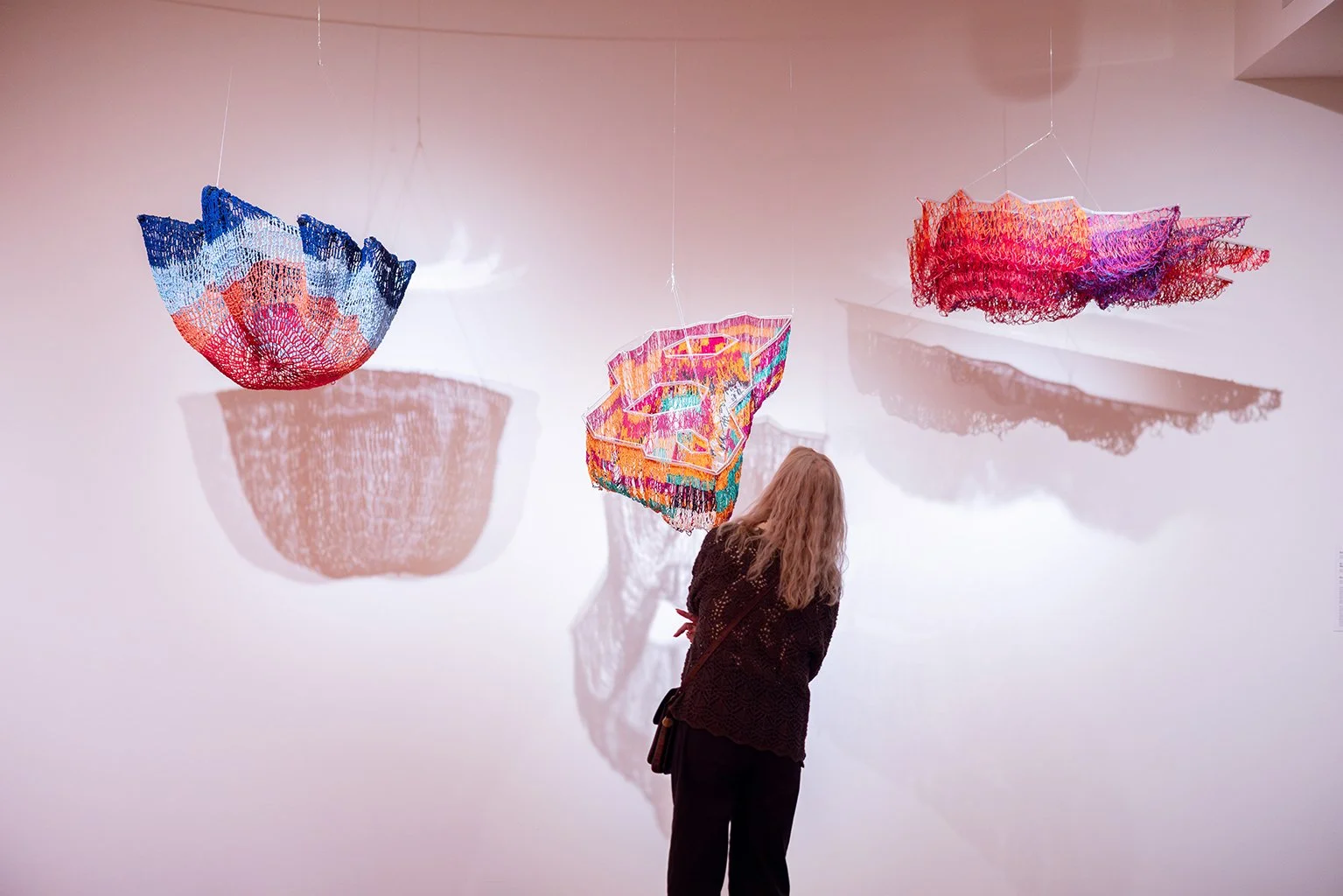
Janet Echelman, Radical Softness installation view. Sarasota Art Museum. Photo: Harry Sayer.
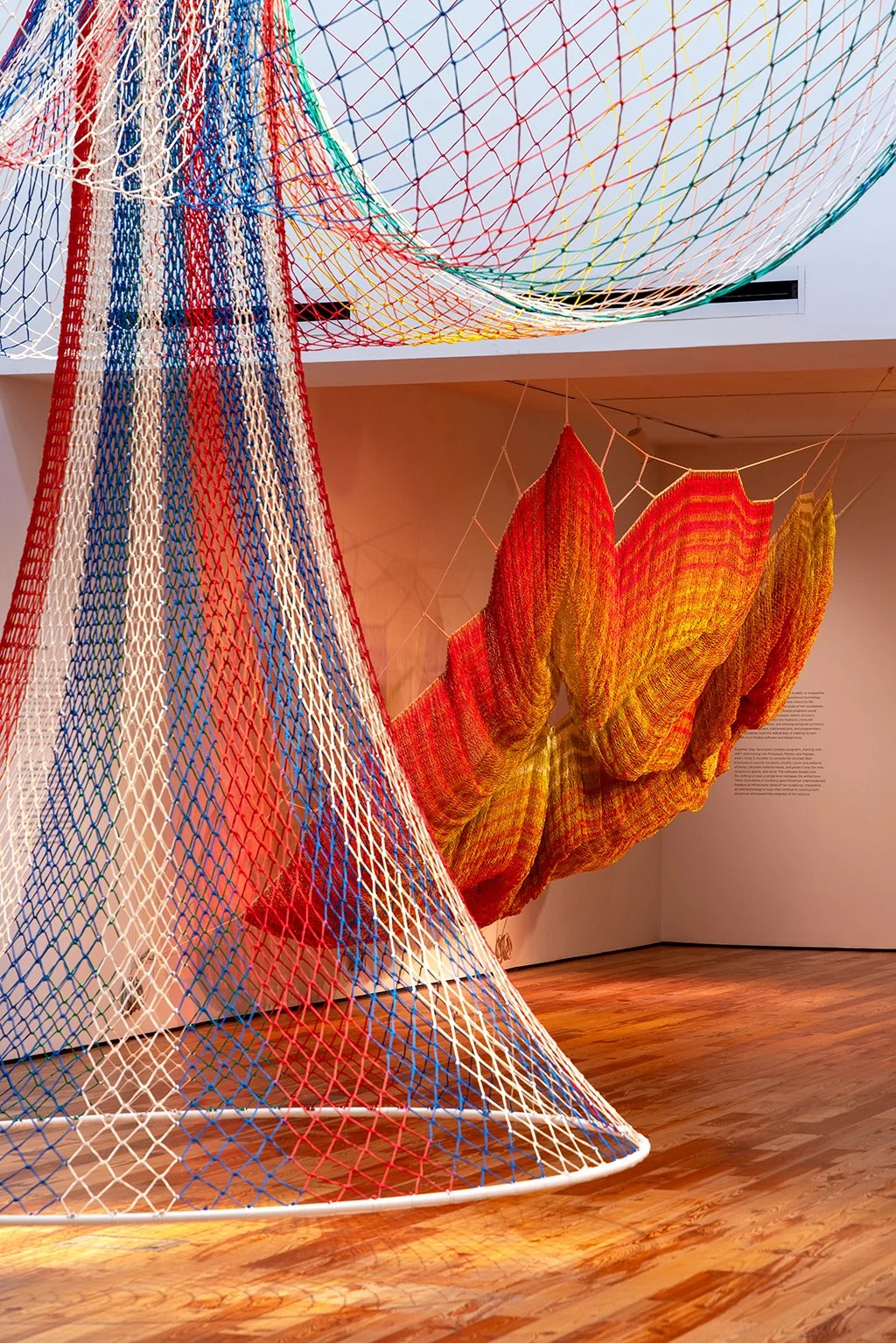
Janet Echelman, Radical Softness installation view. Sarasota Art Museum. Photo: Ryan Gamma Photography.
Radical Softness, organized by the Sarasota Art Museum, takes visitors from Echelman’s earliest work to her most recent: charcoal drawings from her teens, her first batiked canvases, paintings, quilts, early software, and translation into craft. It includes design models made in her studio, samples of the high-strength fiber lines she helped invent, and new cyanotype photographic works. It even features her newest quilts made from the linings of her late husband’s clothing.
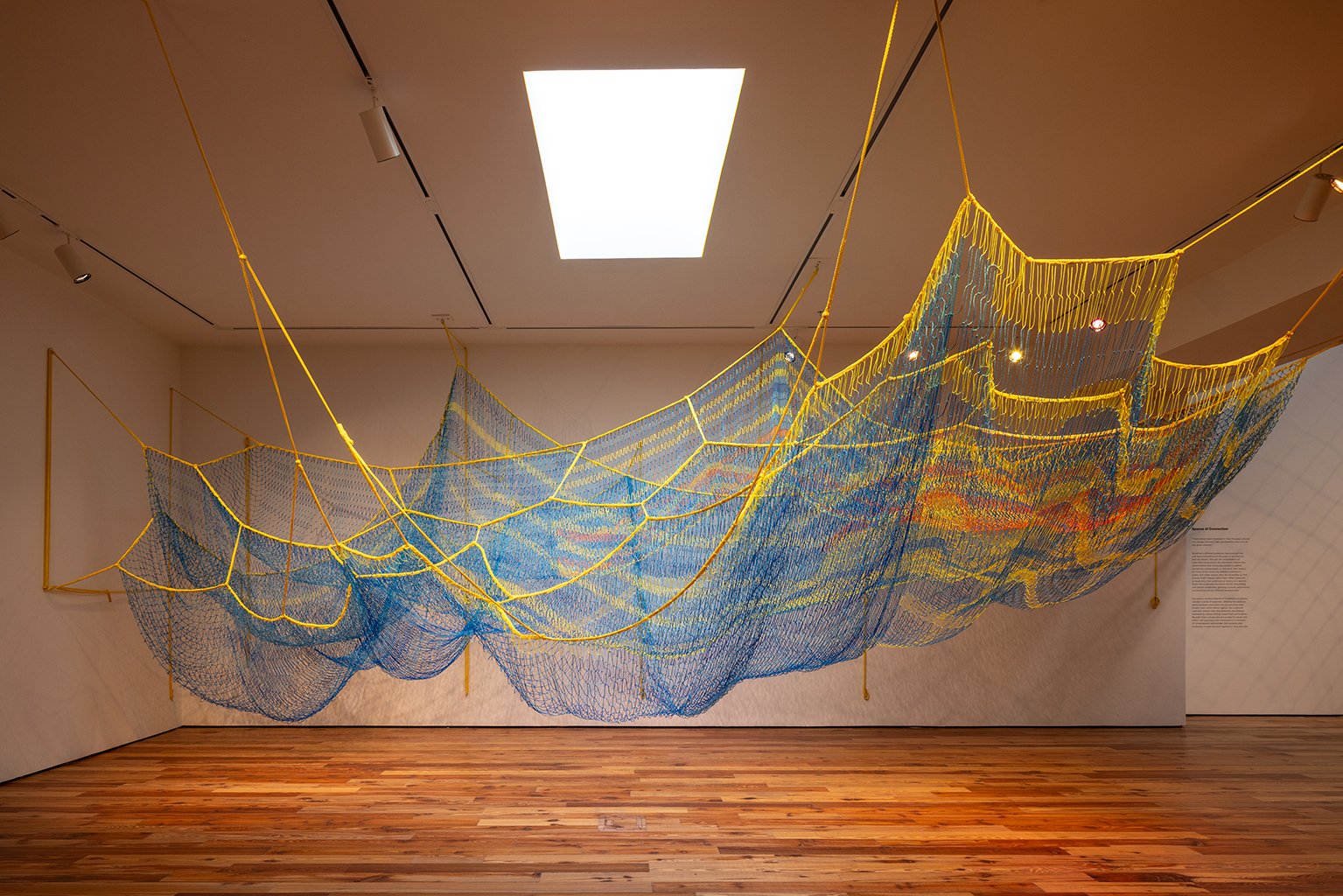
Janet Echelman, Radical Softness installation view, Sarasota Art Museum. Photo: Ryan Gamma Photography.
“It was actually kind of emotional to see my whole life laid out like that,” she said when I asked her about the show. “You look at the early paintings and there are all these interconnected networks: loops and softness and textile. You can see it’s the same person even though [the work is] completely young. You see the gesture, fluid movement. Human gesture is the essence of humanity.”
Echelman runs her practice independently with her team at Studio Echelman. She has built her audience and demand directly, since her work defies genre and is primarily executed on a municipal scale. She is one of the country’s most important artists, exporting work all over the world, and she does it firmly outside of the gallery system. She braids a dozen skill sets into the title of artist: designer of urban spaces, chronicler of climate science, visionary in computer software design and data visualization, mentor, and curator of collaborators including computer and material scientists, city governments, choreographers, composers, Indian fishermen and Lithuanian lace makers. She is a social scientist whose grand experiments show us how everything and everyone is interconnected, and how the experience of awe can remind us of that truth.
Under Echelman’s diaphanous, sky-spanning sculptures, neglected areas become vibrant destinations where people come to feel alive: places like Civic Space Park in downtown Phoenix, site of Her Secret is Patience (2009), the Pier District in St. Petersburg, Florida, site of Bending Arc (2020), and Frankfurt's Konstablerwache public square (known as Konti), where A Sky Full of Hope – Earthtime 1.78 Frankfurt opened in August.
“It’s about lightness and softness as an alternate way of being in the world.”
As If It Were Already Here made this type of impact on Boston from May 3 to October 25, 2015. The Rose Kennedy Greenway Conservancy commissioned the work as a signature of their new public art program, hoping to draw attention and crowds to the 17-acre park built over the Big Dig—site of the six-lane Central Artery which had split the city from the waterfront since the 1950s.
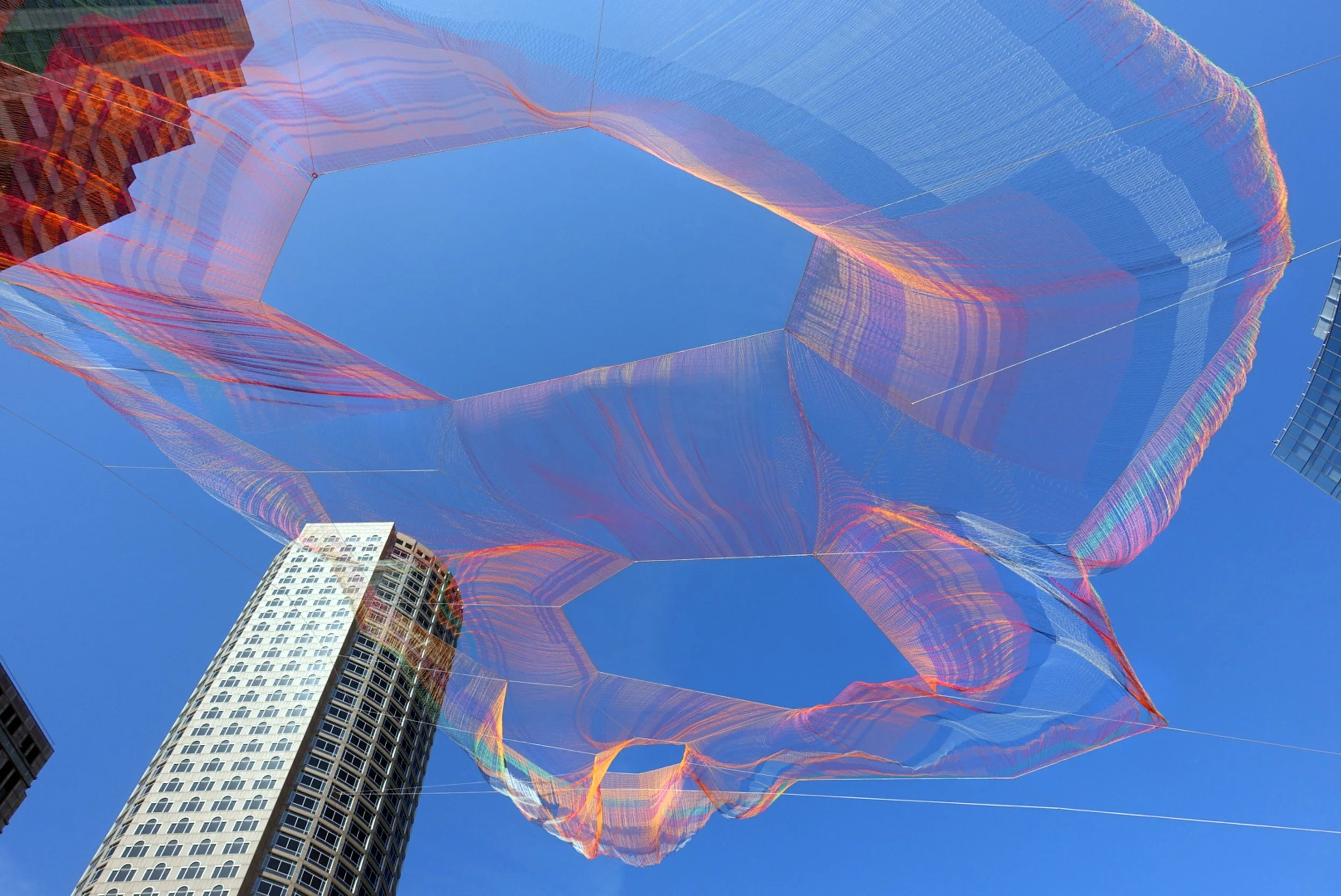
Janet Echelman, As If It Were Already Here, Boston, 2015. Photo: Melissa Henry.
I remember lying under As If It Were Already Here one evening on my way home from work. I’d been racing to catch a train at South Station when the alien miracle of Echelman’s sculpture stopped me short. As big as a lake and undulating like water, it drew me off Congress Street into the park. The hammocks the Conservancy had put out were full; I lay down in the grass. I watched the endless knots holding the structure’s shape while allowing it to billow and dance in the wind. I was mesmerized by the bands of orange, red and green glowing against the monotonous grey skyline. The work stretched overhead like a benevolent weather event, a geometric miracle uniting all of us in the park. All around me people were lying down too, or standing still. Everyone was looking up.
Later I would learn that Echelman’s design with its three voids was a nod to Boston’s Trimountain (later shortened to Tremont): three hills razed in the 19th century for land reclamation projects, the color bands represented the six lanes of traffic, and that her vision was to “sew the city together” after being dissected by the elevated highway. But at the time all I knew was that it infused me with a sparkly sense of optimism.
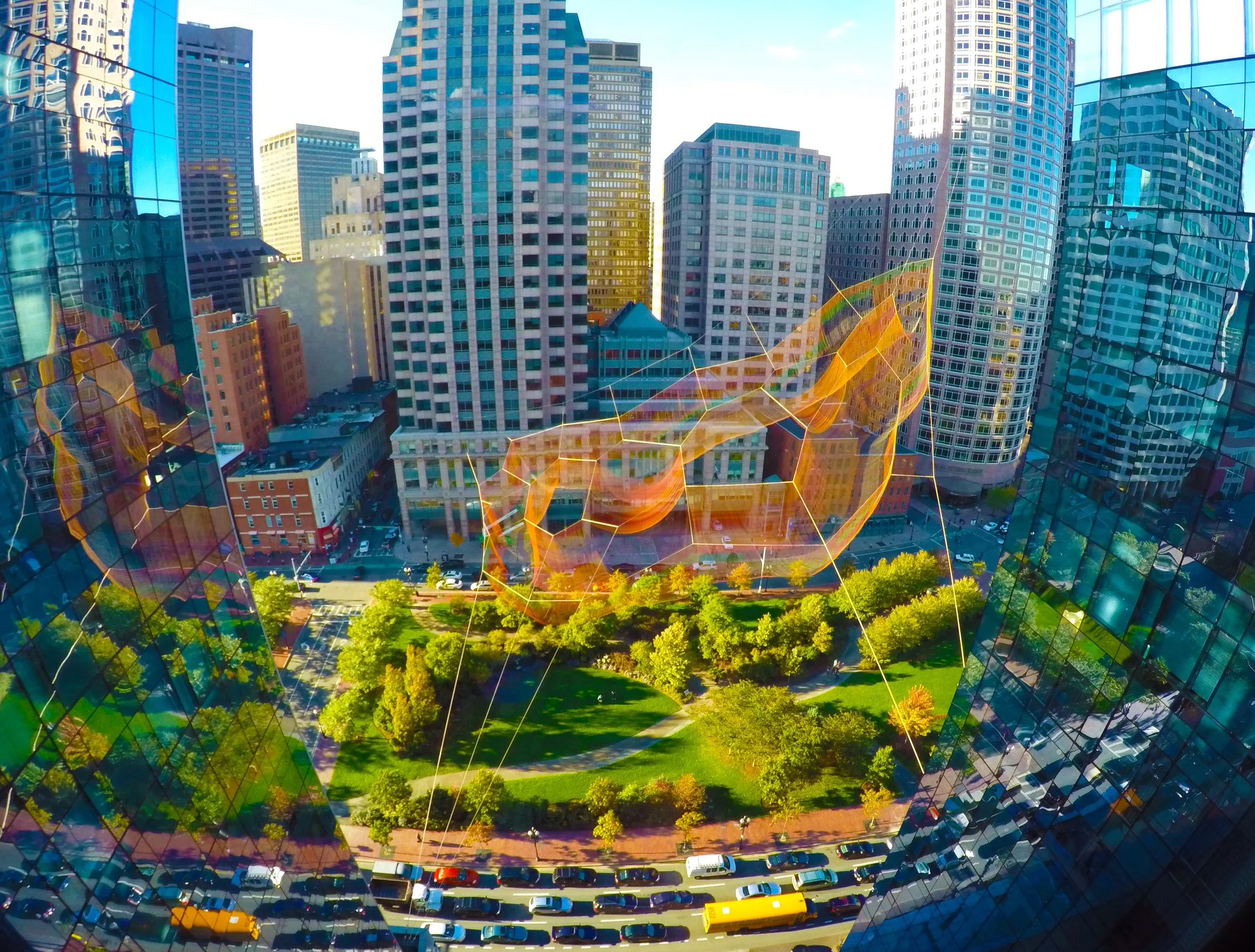
Janet Echelman, As If It Were Already Here, Boston, 2015. Photo: Bruce Petschek.
As If It Were Already Here won the Boston Society of Architect’s (BSA) People's Choice Award in 2018. It then won the Harleston Parker Medal in 2022, as the most beautiful structure in metro Boston of the prior decade—the first time the prize went to a temporary public artwork rather than a permanent building. Sarah Williams Goldhagen, former architecture critic for The New Republic, wrote in Radical Softness: The Responsive Art of Janet Echelman, edited by Gloria Sutton: “Buildings are inert, hard, planar, and usually monochromatic, yet here was an urban moment that unfolded over time in a soft, permeable, colorful experience of nature.”
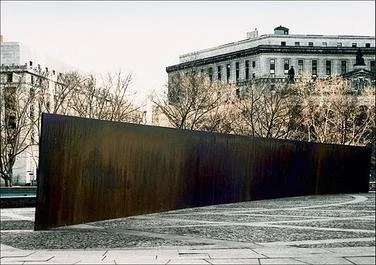
Richard Serra, Tilted Arc, displayed in Foley Federal Plaza in Mabhattan from 1981 - 1989, and cut apart and hauled away in 1989 after public hearings. Photo: Wikipedia.
Echelman thinks a lot about resiliency as an alternate route to strength. When she was starting out as an artist, (she studied batik in Bali, calligraphy in Hong Kong, and lace making in Lithuania, before her famous residency in India), she read about Richard Serra’s Tilted Arc and was inspired to create a feminist response. “You can put up a giant, willful, 120-foot-long, 12-foot-high, 73 ton sheet of steel—think of the embodied energy of creating and transporting that work—and then compare it to a work of mine, like Boston, which stretched multiple city blocks, but instead of blocking people, it allowed the wind, weather, sun, and people to move and see through it, and the whole thing weighed less than one ton.”
“It’s about lightness and softness as an alternative way of moving in the world: softly and resiliently and adapting rather than pushing. Taking up space without apology, being incredibly strong and radically soft.”
Her softness is radical because it operates at architectural scale, but refuses the insistence that strength means dominating, aggressive, unyielding—characteristics of Tilted Arc. Richard Serra's defenders argued that Tilted Arc made people conscious of their own bodies moving through space, and that public art shouldn't have to please. But the public did not agree and the sculpture was removed in 1989. Gloria Sutton explains in her Introduction to Radical Softness, “…in Echelman’s skillful handling, softness is reimagined as an advantage… so-called soft skills like negotiation and compromise are key to Echelman’s proven ability to maneuver through calcified layers of bureaucracy to build public works in some of the most technically challenging environments on the planet...”
This sentiment strikes me as related to what Echelman told me about learning ancient knotting and splicing techniques from fishermen in Mahabalipuram, India, when her paints didn’t arrive during her 1997 Fulbright Lectureship (a story made famous by her TED Talk which has been viewed over 2.6 million times and translated into 35 languages). “This was another approach, and I liked it because this was technology, old technology. It wasn’t high art, it wasn't decorative craft, it was livelihood. Humans used this to survive.”
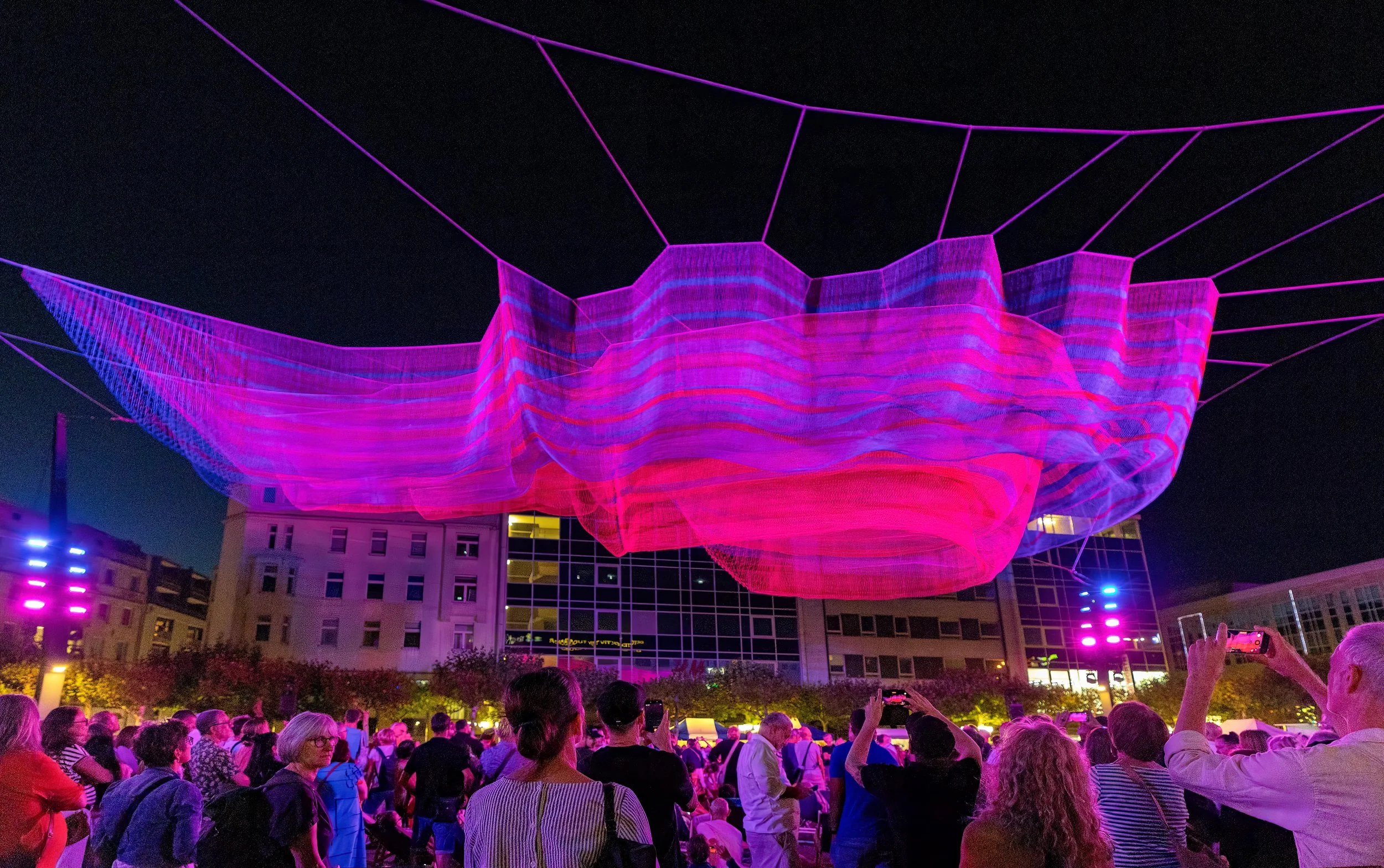
Janet Echelman, A Sky Full of Hope – Earthtime 1.78 Frankfurt (2026). Photo Amy Martz.
Echelman was recently back from Frankfurt when we met. The opening of her work A Sky Full of Hope - Earthtime 1.78 Frankfurt, Germany, 2026 had been especially exciting for her, because of how significantly the work altered the environment. She showed me pictures of the three thousand attendees congregating under the canopy of her work, relaxing in lounge chairs provided by the city, not wanting to leave. The deputy mayor told Echelman she'd never before seen people electing to stay in that space, the terminus of a pedestrian shopping street with a subway station underneath. It had a reputation as a sketchy area to avoid. Now, she reports proudly, the place is alive with visitors.
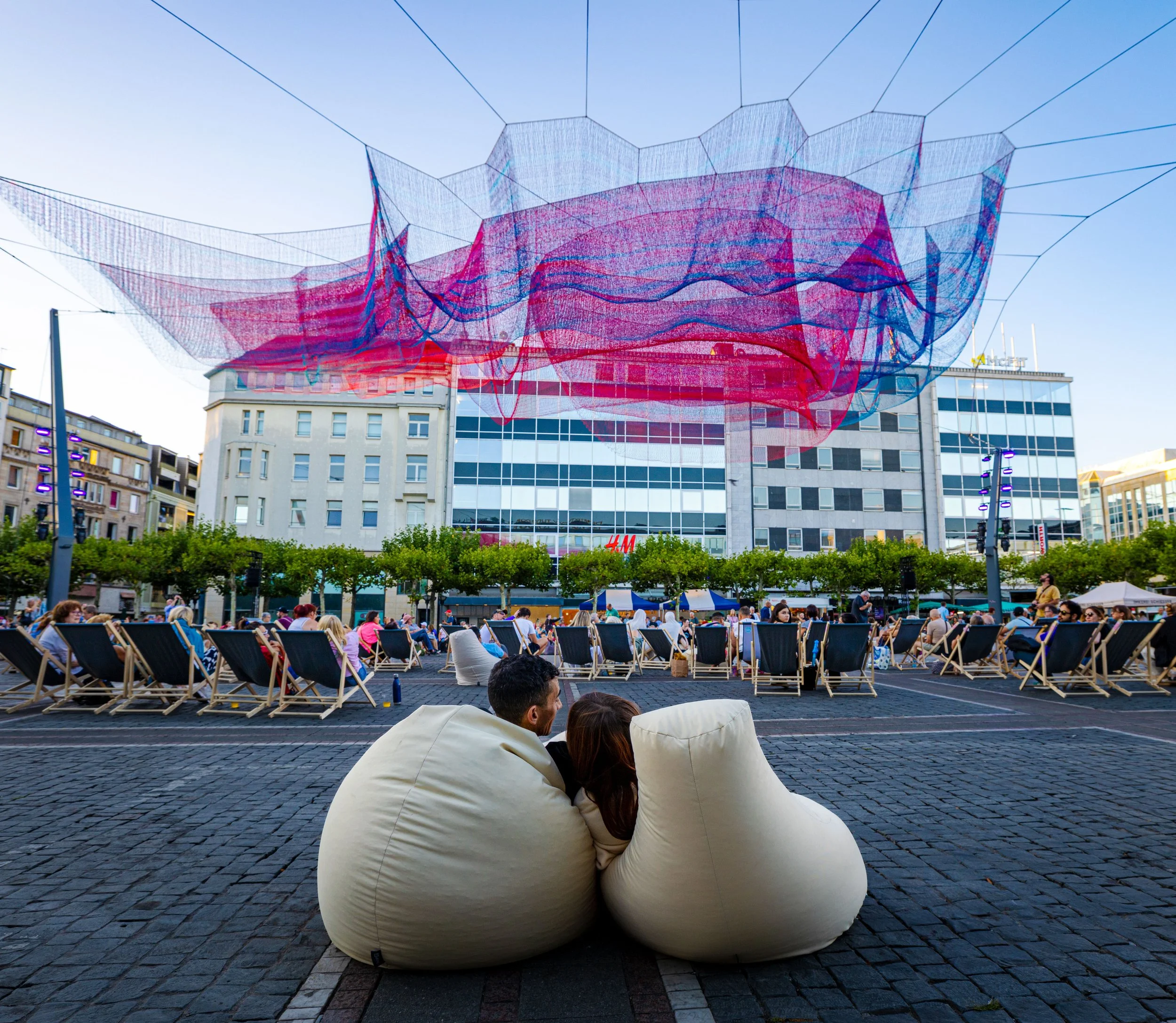
Janet Echelman, A Sky Full of Hope – Earthtime 1.78 Frankfurt (2026). Photo Amy Martz.
Fiber and craft-based work by women has long been dismissed by the art-historical canon. That is changing, with institutional recognition of artists like Anni Albers, Magdalena Abakanowicz, Sheila Hicks, Ruth Asawa, and Faith Ringgold, but the old hierarchy still haunts collections, the market, and art school curricula. Echelman's installations are monuments to women's potential and power. And yet what I find so liberating and exciting about her work is that she refuses the terms of the argument entirely: not high art, not decorative craft, but actual urban fabric. Her sculptures don't hang inside buildings or stand outside them. They hang between them, using the city's architecture as their armature.
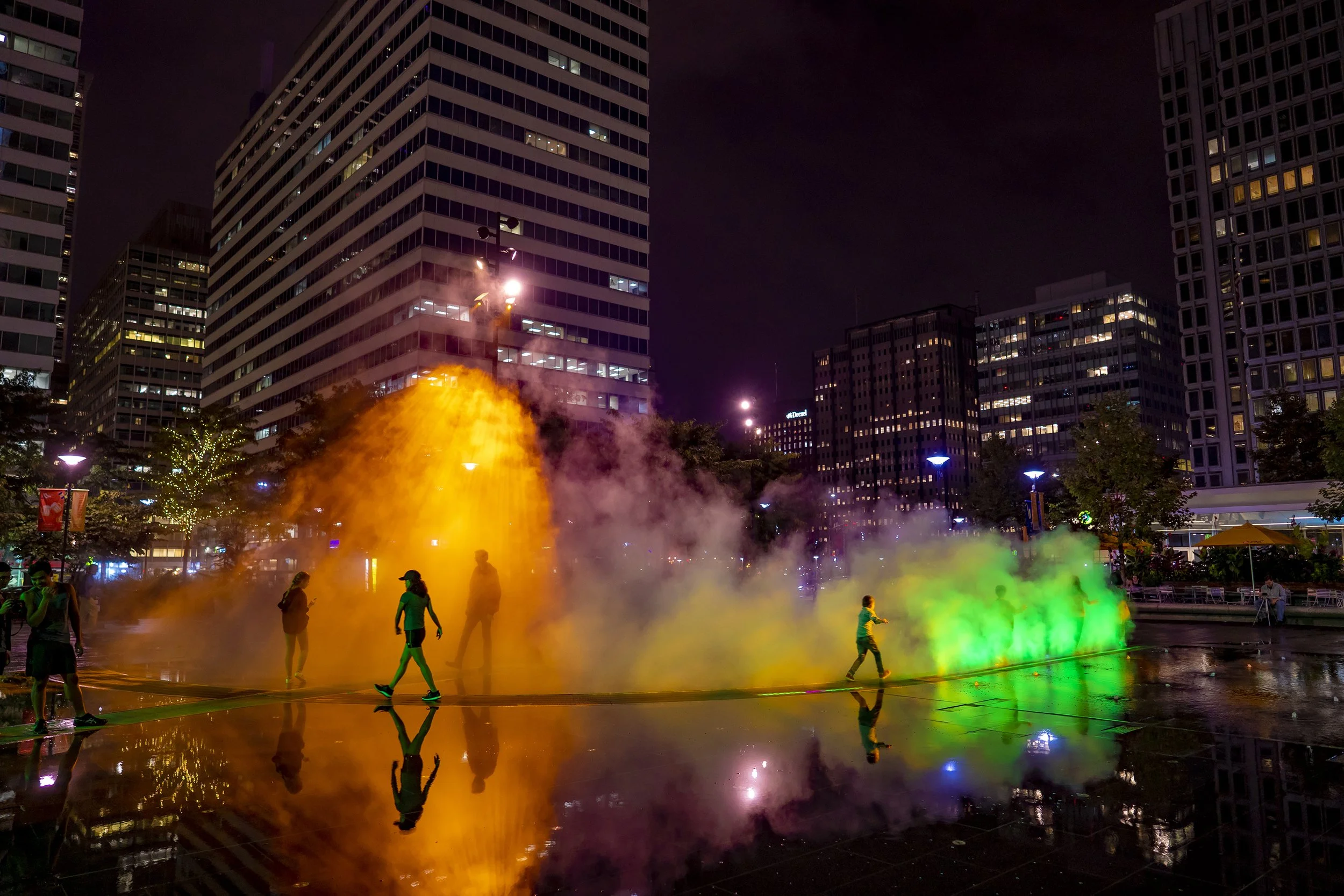
Janet Echelman, Pulse (2018), Philadelphia. Photo: Jeff Fusco.
Like her sculptures, Echelman is never still. Each commission requires her to learn or develop something new. In Philadelphia, Pulse, Philadelphia, PA Green line phase, 2018 required her and her team to sculpt with atomized water particles and design grates strong enough to withstand ambulances and firetrucks.
For the ongoing performance installation Noli Timere, she learned how to create netting that would allow dancers to dance on, around, and inside of it.
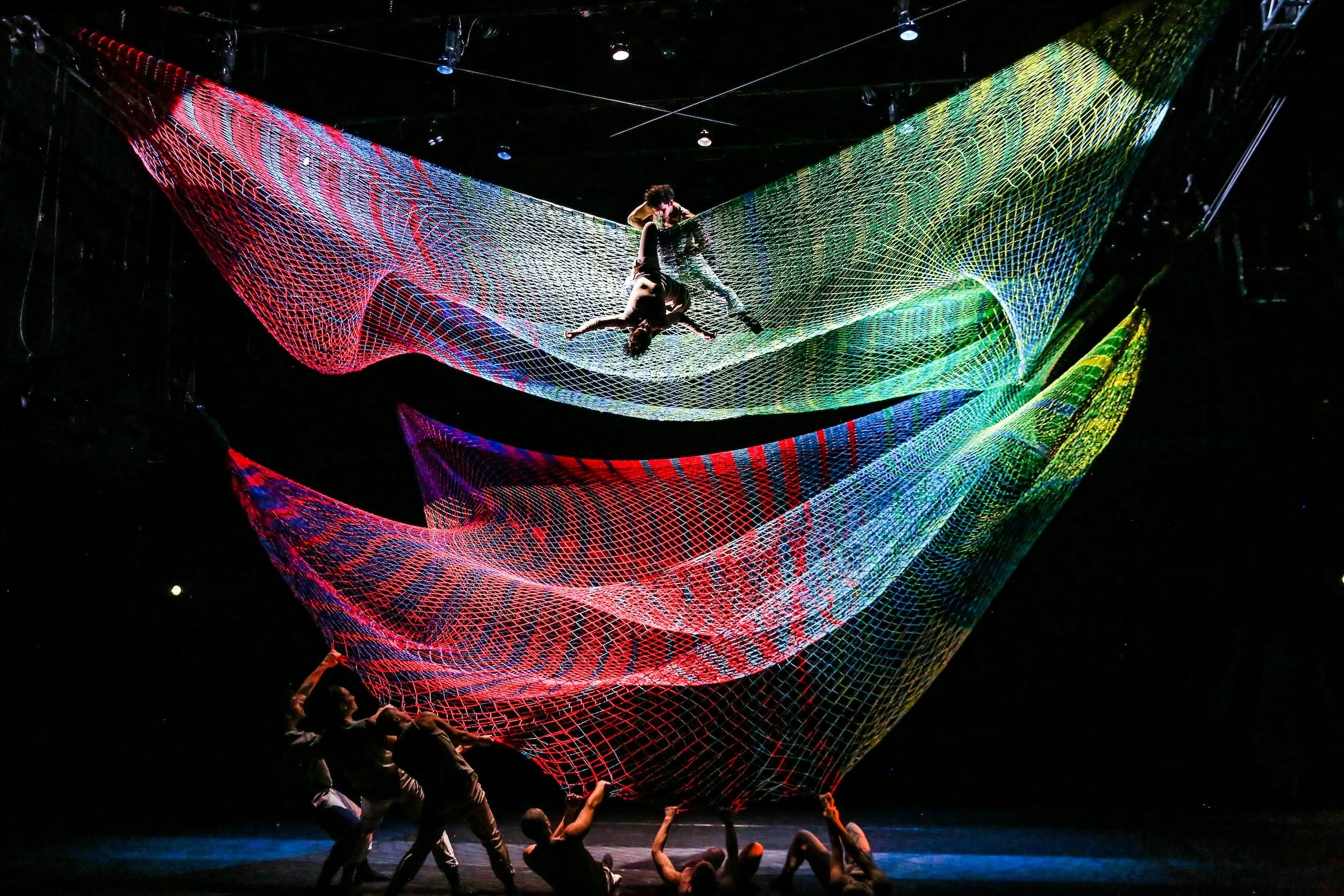
Janet Echelman, Noli Timere, ongoing. Photo: Julie Lemberger.
In addition to computer modeling, material exploration drives much of the studio’s ability to take on increasingly complex commissions. The artist shows me what a “line” looks like in her sculptures now, the result of decades of innovation. Each sculpture requires specific fiber types, able to handle the force load and climate conditions. Echelman collaborates with industrial fiber manufacturers that make materials for things like body armor and bridge lifting slings. She showed me a sample of a custom rope construction that includes ultra-high-molecular-weight polyethylene—more than fifteen times stronger than steel and light enough to float—and the UV-resistant and colorfast fiber wrapping the lines. This material is used for things like rash guards and stadium covers - think Wimbledon’s Centre Court.
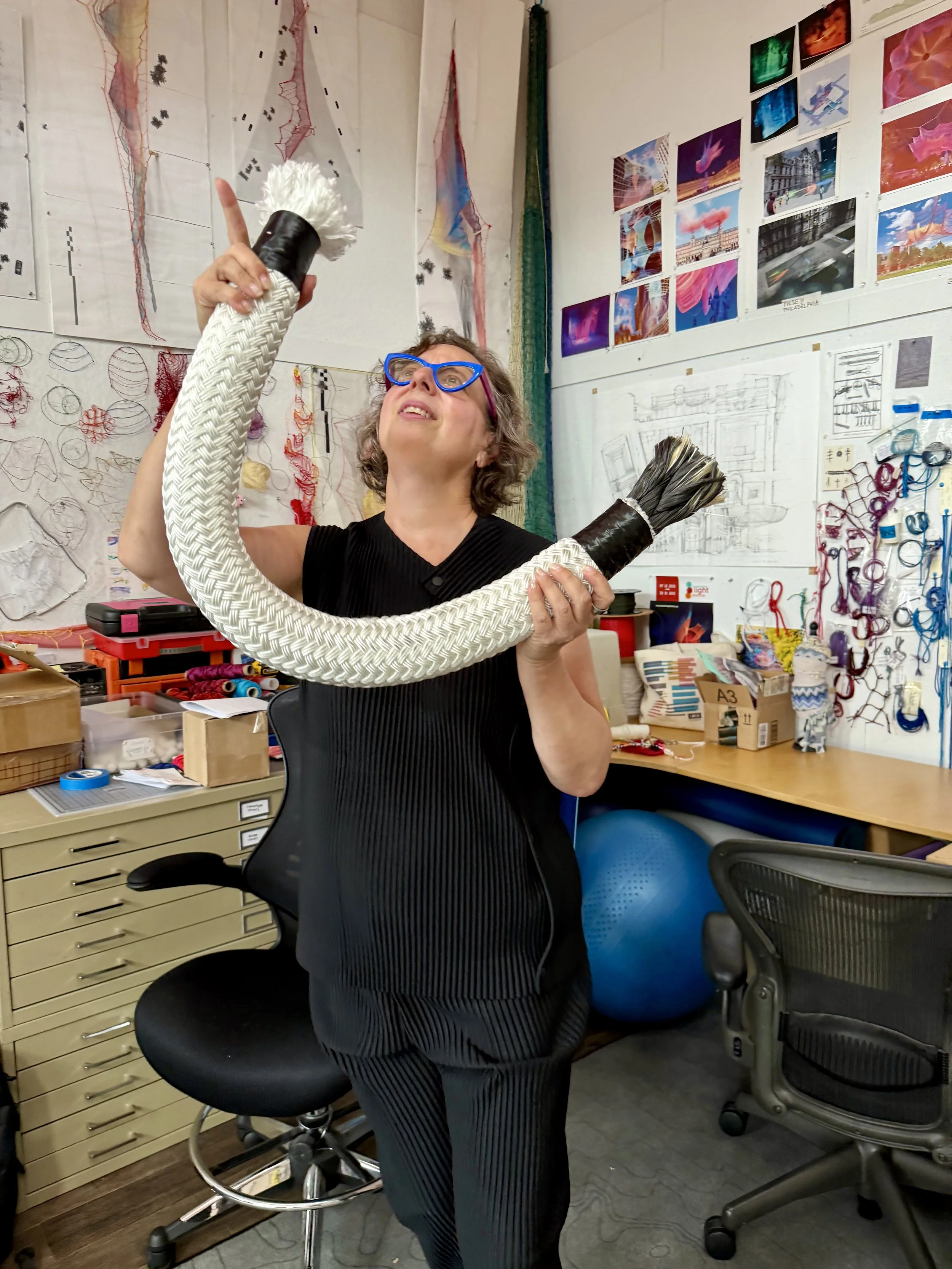
The artist in her studio with a line sample. Photo: Robin Hauck.
The book accompanying Radical Softness includes a comprehensive index of Echelman’s sculptures. Prolific is not a strong enough description. Her work has been shown on five continents in all kinds of settings. She has collaborated with the likes of Swizz Beatz and Melinda Gates, and Michelle Obama touted her work on social media. Her Earthtime series provides a sense of her global influence. The Earthtime 1.26 sculpture has been installed in 15 cities on 4 continents: Denver, Colorado (2010), Sydney, Australia (2011), Amsterdam, Netherlands (2013), Singapore (2014), Montreal, Canada (2015, 2016, 2017), Prague, Czech Republic (2015), Durham, UK (2015), Santiago, Chile (2016), Shanghai, China (2017), Chiayi, Taiwan (2018), Hong Kong, China (2018), Geneva, Switzerland (2020), Munich, Germany (2021), Jeddah, Saudi Arabia (2021), and Milan, Italy (2022). The Earthtime 1.8 sculpture has been installed in: London, UK (2016), San Diego, CA (2016), Mexico City, Mexico (2017), Beijing, China (2017), Xian, China (2018), Green Mountain Falls, CO (2019), and Perth, Australia (2021).
“When I first encountered “Earthtime 1.26 Jeddah” it felt like the ocean was moving in the sky — the piece was alive.”
If we’re paying attention, the weight of our interconnectedness feels simultaneously heavier and more liberating with each new work. More liberating because Echelman reminds us that we are never alone, we are one global community. Heavier because she illustrates our individual and shared responsibilities to the planet. This is startlingly evident in Echelman’s installation Remembering the Future at the MIT Museum in Cambridge, MA, created during her residency as MIT ‘s Mellon Distinguished Visiting Artist from 2022 to 2024.
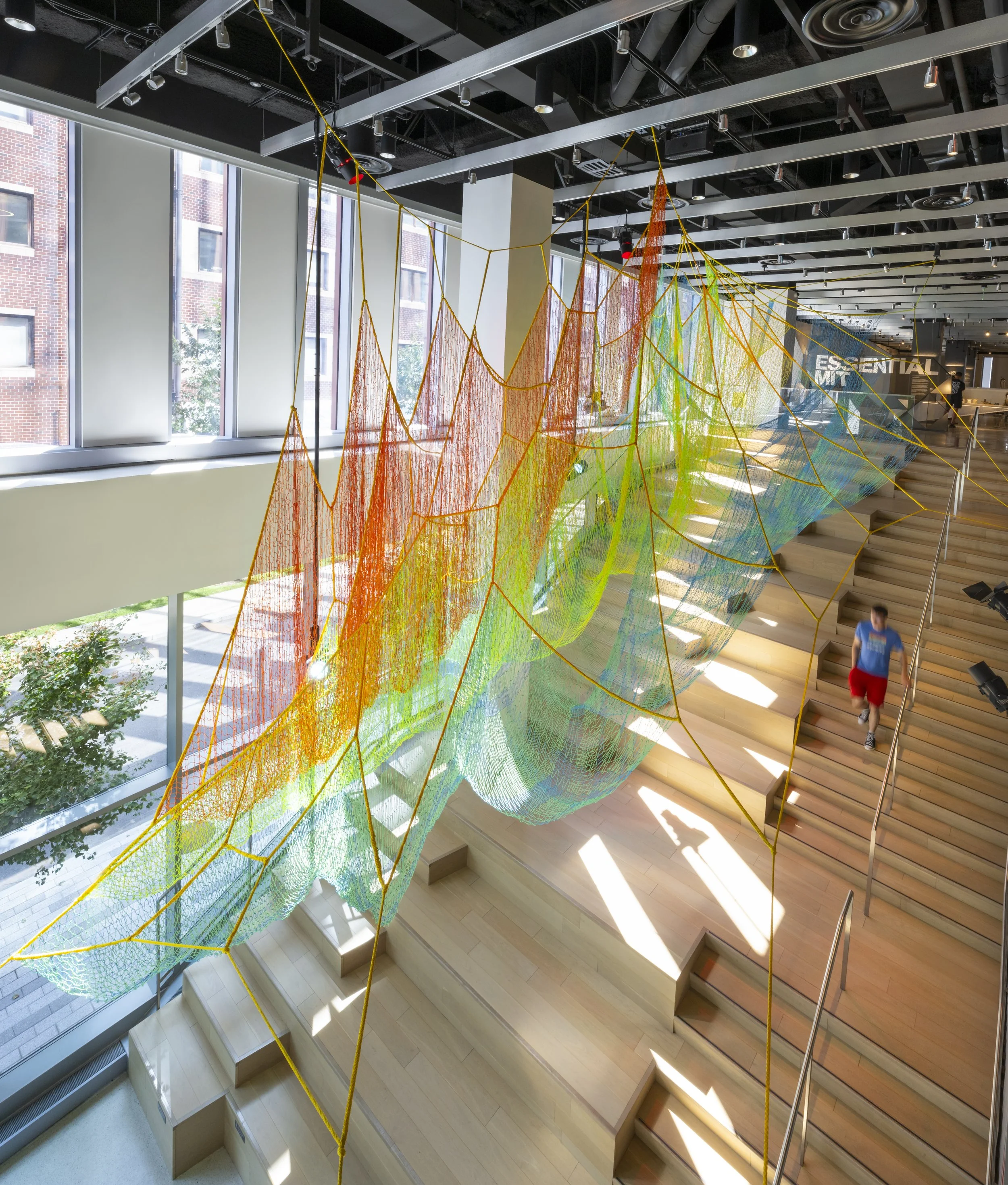
Janet Echelman, Remembering the Future, MIT Museum, 2025. Photo: Anna Olivella.
A member of Studio Echelman had left to do grad work at MIT, and the studio co-sponsored his degree. As his capstone project, he built a new tool for finding tensile equilibrium, where all the forces at work in the piece are in balance. It allows the team to move nodes representing knots and points of tension, and calculates the new geometry. What they found when they analyzed the structure was that the greatest force is in the present moment—the point where the past and the future come together. In this way, the piece reveals in color and shape the planet’s climate history and potential futures.
“The truth conceptually was also the truth in the physics. That was a discovery, made after the entire exhibit was in place. [The work shows] the past and the future coming together at this moment of now. And we know that what we do now will shape the future.”
“For me, climate news and everything makes me want to run away, because I don't know what to do with it. It’s overwhelming, and there’s no entry for a lay person like me. So this is a piece where you can quietly sit with the past and the future. My belief is that there is a great deal of loss already. We have no space to grieve. By having a place to feel that, it liberates us to have our agency for action. That was the framework—a quiet piece—not a tell-you-what-to-do. These are the different possible futures, this is the past. You feel the physics, even if you don't know it. You feel that tension.”
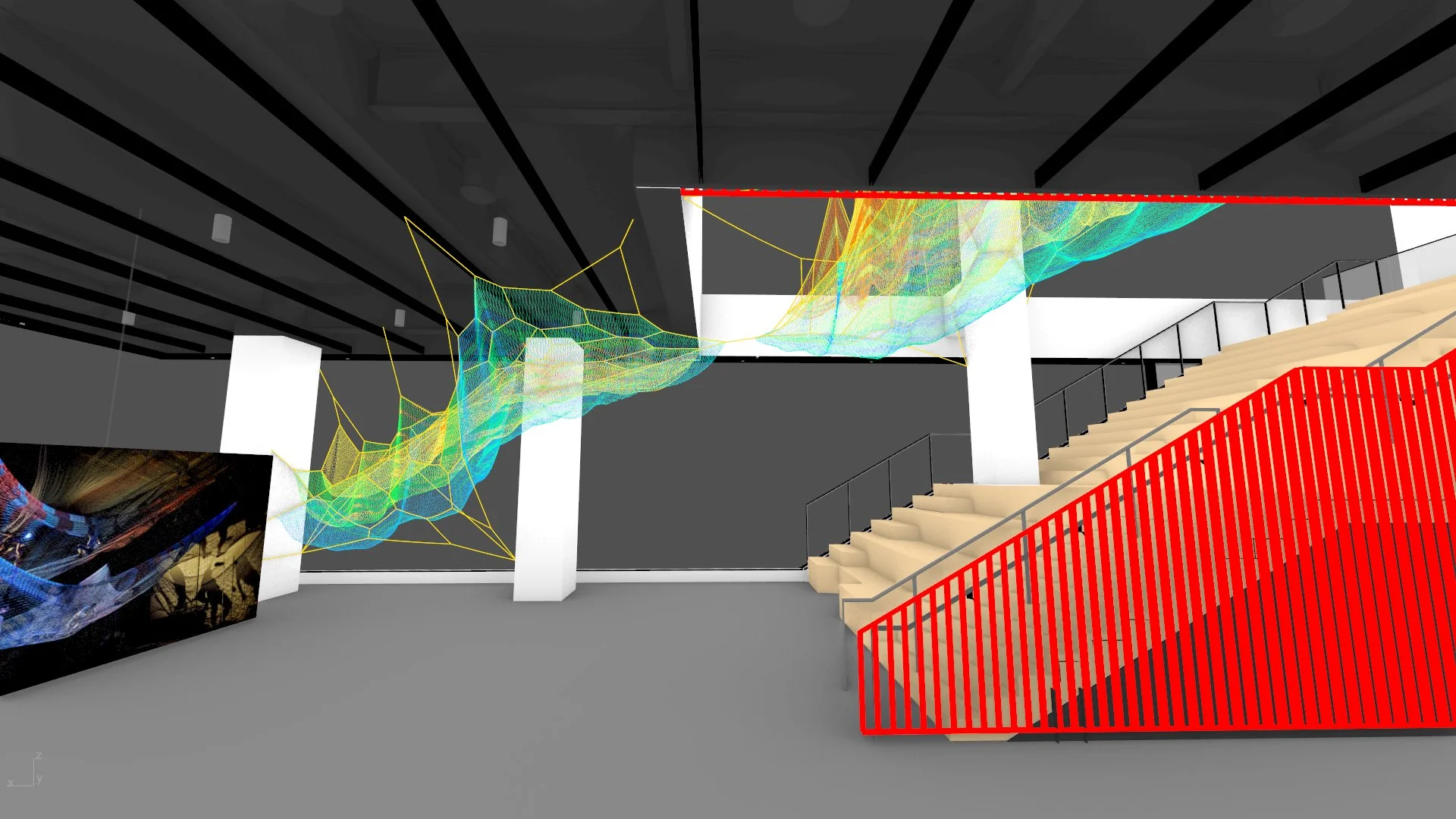
Image courtesy of Studio Echelman.
“Revealing the interconnectedness of networked systems — urban, environmental, human — Echelman’s sculptures visualize the patterning of nature, the unrelenting force of climate change, and a feminist determination to create an inclusive space for all bodies and all ages. ”
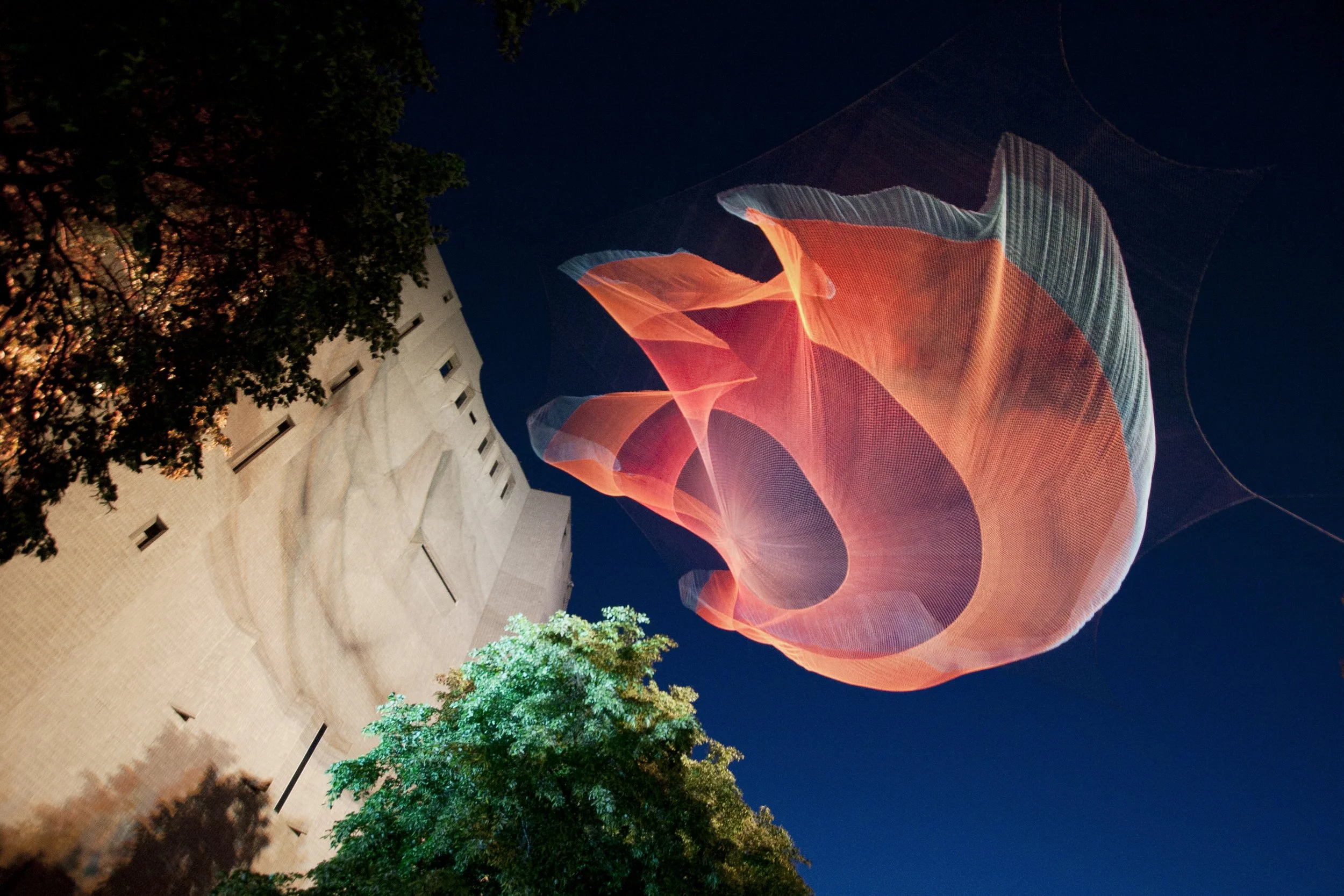
Janet Echelman, Earthtime 1.26, Denver, Colorado, 2010. Photo Janet Echelmaan.
Cities need ways to offer their citizens moments of awe — experiences that take them out of themselves and toward a sense of shared existence. Echelman hoists hers over technical, natural, bureaucratic, financial, material, and temporal hurdles. What pulled me out of my march to the train that evening in 2015 was a canopy banded in the colors of the six lanes that once ran overhead, where the elevated highway had severed the city from its harbor. Softness had taken the place of the thing that divided us, and all of us were looking up.
Important Dates:
Janet Echelman: Radical Softness at Tephra ICA September 17 - March 20, 2027.
Janet Echelman: Remembering the Future at the MIT Museum September 2025 - August 2027
All photos courtesy of the artist and Studio Echelman.